Ch. 1 - Equations and Inequalities
Blitzer - College Algebra 8th Edition
Blitzer8th EditionCollege AlgebraISBN: 9780136970514Not the one you use?Change textbook
Chapter 2, Problem 62a

Write each complex number in standard form. (1 - i)3

Verified step by step guidance
1
Rewrite the expression \((1 - i)^3\) using the binomial theorem, which states \((a + b)^n = \sum_{k=0}^n \binom{n}{k} a^{n-k} b^k\). Here, \(a = 1\), \(b = -i\), and \(n = 3\).
Expand the binomial expression: \((1 - i)^3 = \binom{3}{0}(1)^3(-i)^0 + \binom{3}{1}(1)^2(-i)^1 + \binom{3}{2}(1)^1(-i)^2 + \binom{3}{3}(1)^0(-i)^3\).
Simplify each term: \(\binom{3}{0}(1)^3(-i)^0 = 1\), \(\binom{3}{1}(1)^2(-i)^1 = -3i\), \(\binom{3}{2}(1)^1(-i)^2 = 3(-1) = -3\), and \(\binom{3}{3}(1)^0(-i)^3 = -i\).
Combine the simplified terms: \(1 - 3i - 3 - i\).
Group the real and imaginary parts to write the complex number in standard form \(a + bi\), where \(a\) is the real part and \(b\) is the coefficient of \(i\).

Verified video answer for a similar problem:

This video solution was recommended by our tutors as helpful for the problem above.
Video duration:
3m
Was this helpful?

Key Concepts

Here are the essential concepts you must grasp in order to answer the question correctly.

Complex Numbers

Complex numbers are numbers that have a real part and an imaginary part, expressed in the form a + bi, where a is the real part, b is the imaginary part, and i is the imaginary unit defined as the square root of -1. Understanding complex numbers is essential for manipulating and performing operations on them, such as addition, subtraction, multiplication, and exponentiation.
Recommended video:
04:22
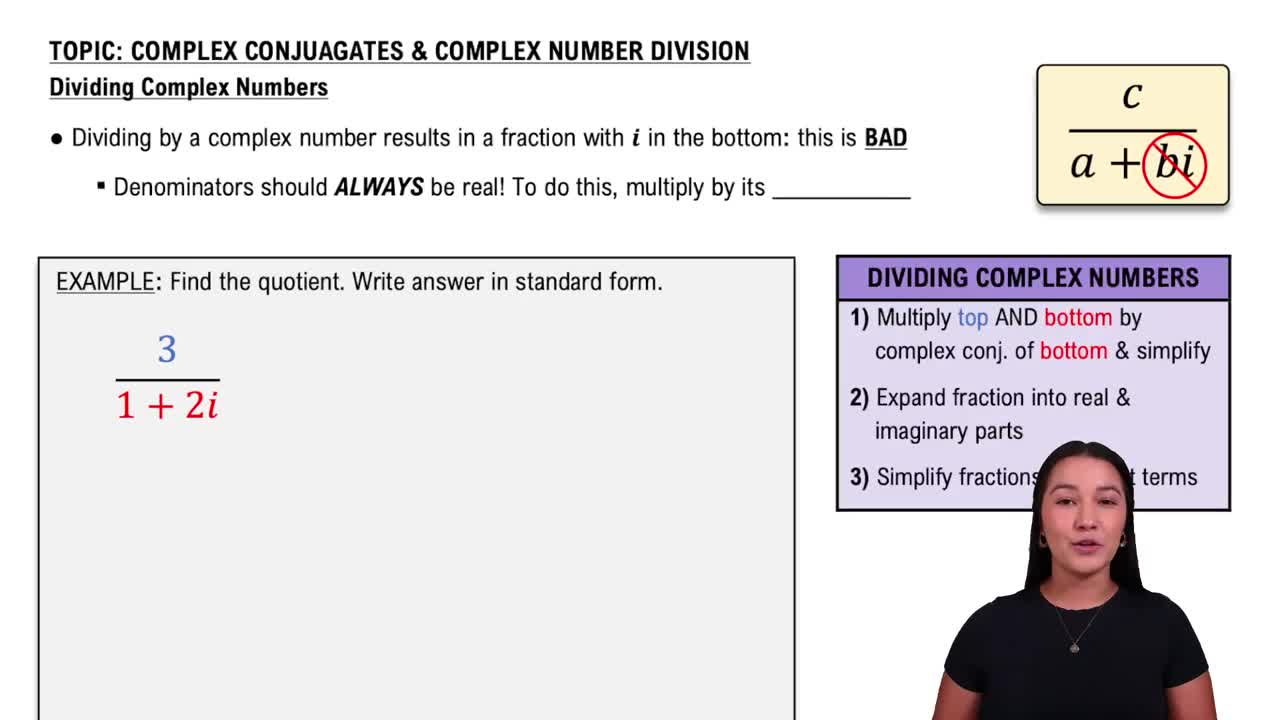
Dividing Complex Numbers

Standard Form of Complex Numbers

The standard form of a complex number is a + bi, where a and b are real numbers. To express a complex number in standard form, one must ensure that the imaginary unit i is isolated in the second term. This is crucial when simplifying expressions involving complex numbers, as it allows for easier interpretation and further calculations.
Recommended video:
05:02
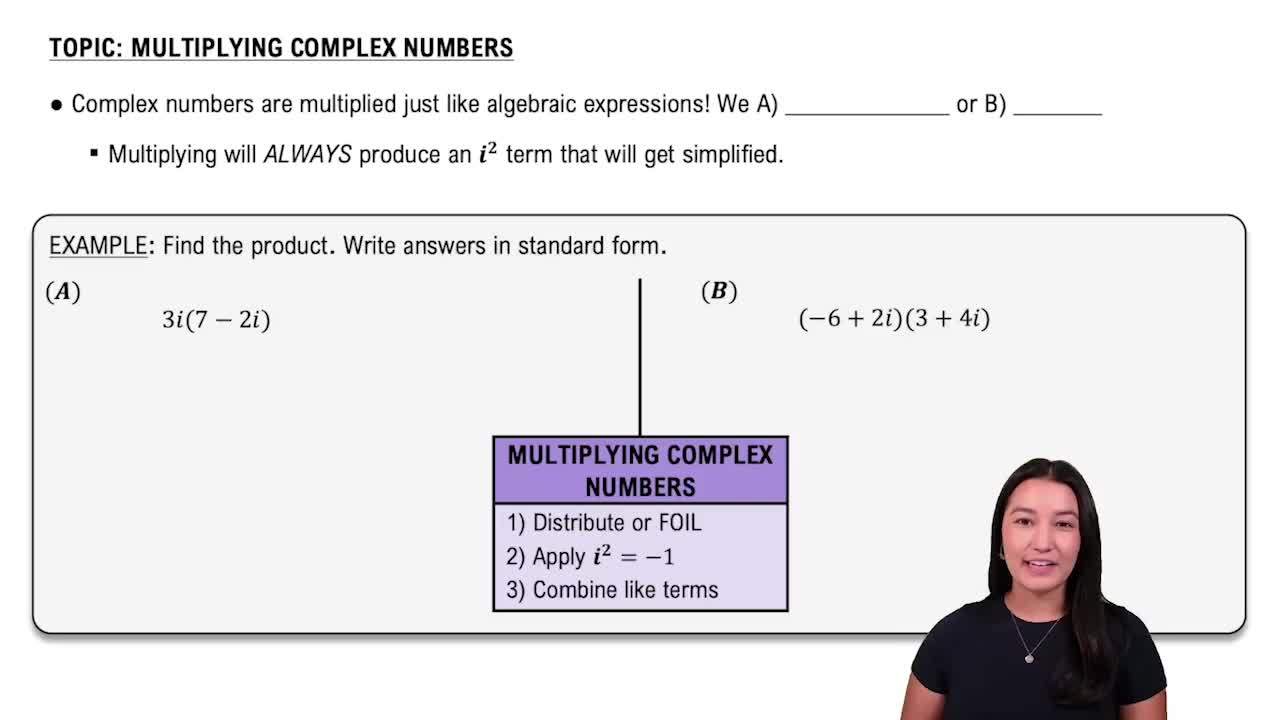
Multiplying Complex Numbers

Exponentiation of Complex Numbers

Exponentiation of complex numbers involves raising a complex number to a power, which can be done using the binomial theorem or De Moivre's theorem. In the case of (1 - i)^3, one can expand the expression using the binomial theorem, which states that (a + b)^n can be expressed as a sum of terms involving combinations of a and b raised to various powers. This process is key to simplifying complex expressions.
Recommended video:
04:22
Dividing Complex Numbers