Ch. 4 - Inverse, Exponential, and Logarithmic Functions
Lial - College Algebra 13th Edition
Lial13th EditionCollege AlgebraISBN: 9780136881063Not the one you use?Change textbook
Chapter 5, Problem 81

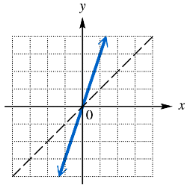
Graph the inverse of each one-to-one function.

Verified step by step guidance
1
Identify the given function on the graph. It is a straight line, which suggests it is a linear function of the form \(y = mx + b\).
Determine the slope (\(m\)) and y-intercept (\(b\)) of the original function by examining the graph. For example, find two points on the line and use the formula \(m = \frac{y_2 - y_1}{x_2 - x_1}\) to calculate the slope.
Write the equation of the original function using the slope and y-intercept found.
To find the inverse function, swap the roles of \(x\) and \(y\) in the equation of the original function. This means replace \(y\) with \(x\) and \(x\) with \(y\) to get an equation in terms of \(y\).
Solve this new equation for \(y\) to express the inverse function explicitly. Then, graph this inverse function by plotting points or using the slope and intercept found from the inverse equation. Remember, the graph of the inverse is the reflection of the original function across the line \(y = x\).

Verified video answer for a similar problem:

This video solution was recommended by our tutors as helpful for the problem above.
Video duration:
1m
Was this helpful?

Key Concepts

Here are the essential concepts you must grasp in order to answer the question correctly.

One-to-One Function

A one-to-one function is a function where each input corresponds to exactly one unique output, and each output corresponds to exactly one unique input. This property ensures the function has an inverse because no two inputs share the same output.
Recommended video:
4:07
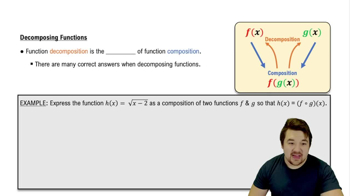
Decomposition of Functions

Inverse Function

The inverse of a function reverses the roles of inputs and outputs, swapping x and y values. Graphically, the inverse function is a reflection of the original function across the line y = x.
Recommended video:
4:30
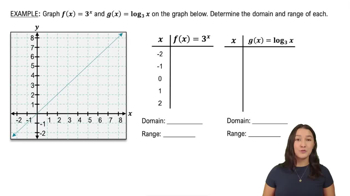
Graphing Logarithmic Functions

Graphing and Reflection Across y = x

To graph the inverse of a function, reflect each point of the original function across the line y = x. This means swapping the coordinates (x, y) to (y, x), which visually demonstrates the inverse relationship.
Recommended video:
4:25
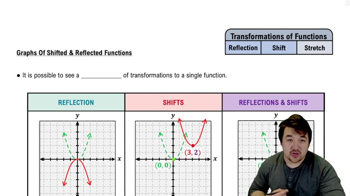
Graphs of Shifted & Reflected Functions