Ch. 3 - Polynomial and Rational Functions
Lial - College Algebra 13th Edition
Lial13th EditionCollege AlgebraISBN: 9780136881063Not the one you use?Change textbook
Chapter 4, Problem 37

For each polynomial function, one zero is given. Find all other zeros. ƒ(x)=x45x24;iƒ(x)=-x^4-5x^2-4; -i

Verified step by step guidance
1
Identify the given polynomial function: \(f(x) = -x^{4} - 5x^{2} - 4\) and the given zero: \(-i\).
Recall that for polynomials with real coefficients, complex zeros come in conjugate pairs. Since \(-i\) is a zero, its conjugate \(i\) is also a zero.
Use the fact that \(x = i\) and \(x = -i\) are zeros to form a quadratic factor: \((x - i)(x + i) = x^{2} + 1\).
Divide the original polynomial \(f(x)\) by the quadratic factor \(x^{2} + 1\) using polynomial division or synthetic division to find the other quadratic factor.
Set the resulting quadratic factor equal to zero and solve for \(x\) to find the remaining zeros of the polynomial.

Verified video answer for a similar problem:

This video solution was recommended by our tutors as helpful for the problem above.
Video duration:
11m
Was this helpful?

Key Concepts

Here are the essential concepts you must grasp in order to answer the question correctly.

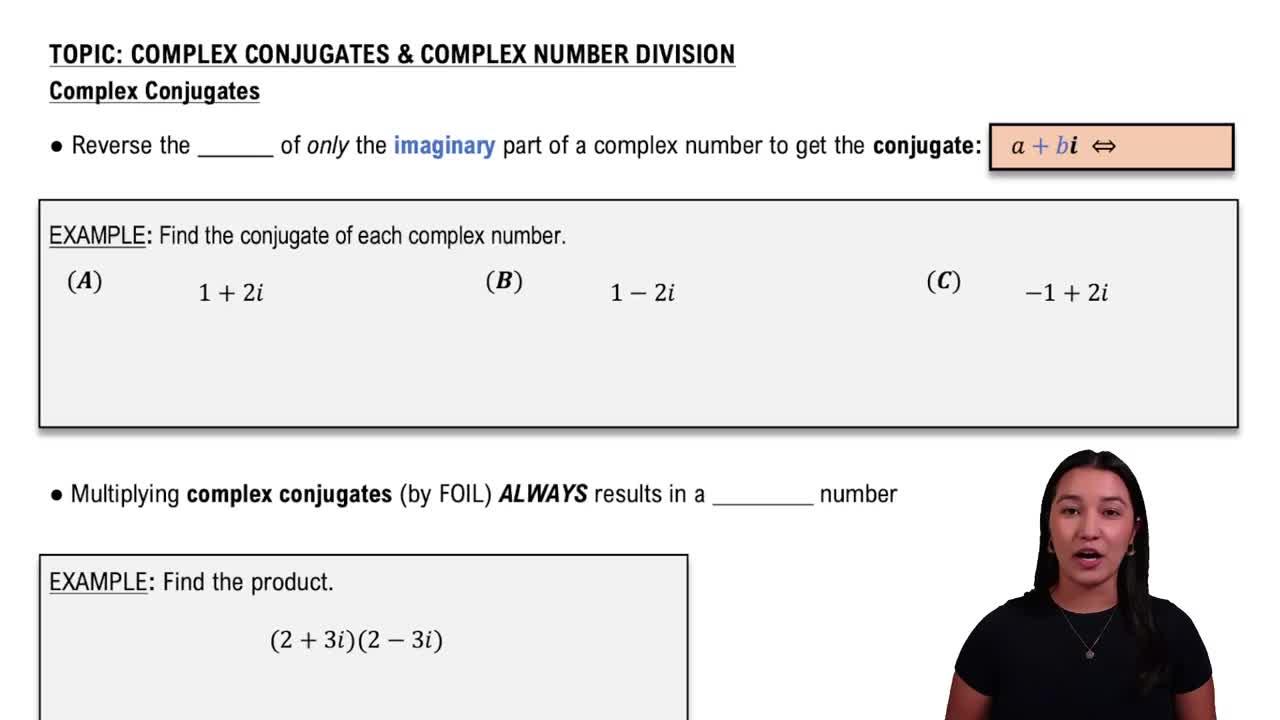
Complex Conjugate Root Theorem

This theorem states that if a polynomial has real coefficients and a complex number a + bi is a root, then its conjugate a - bi is also a root. Since -i is given as a zero, its conjugate i must also be a zero of the polynomial.
Recommended video:
05:33
Complex Conjugates

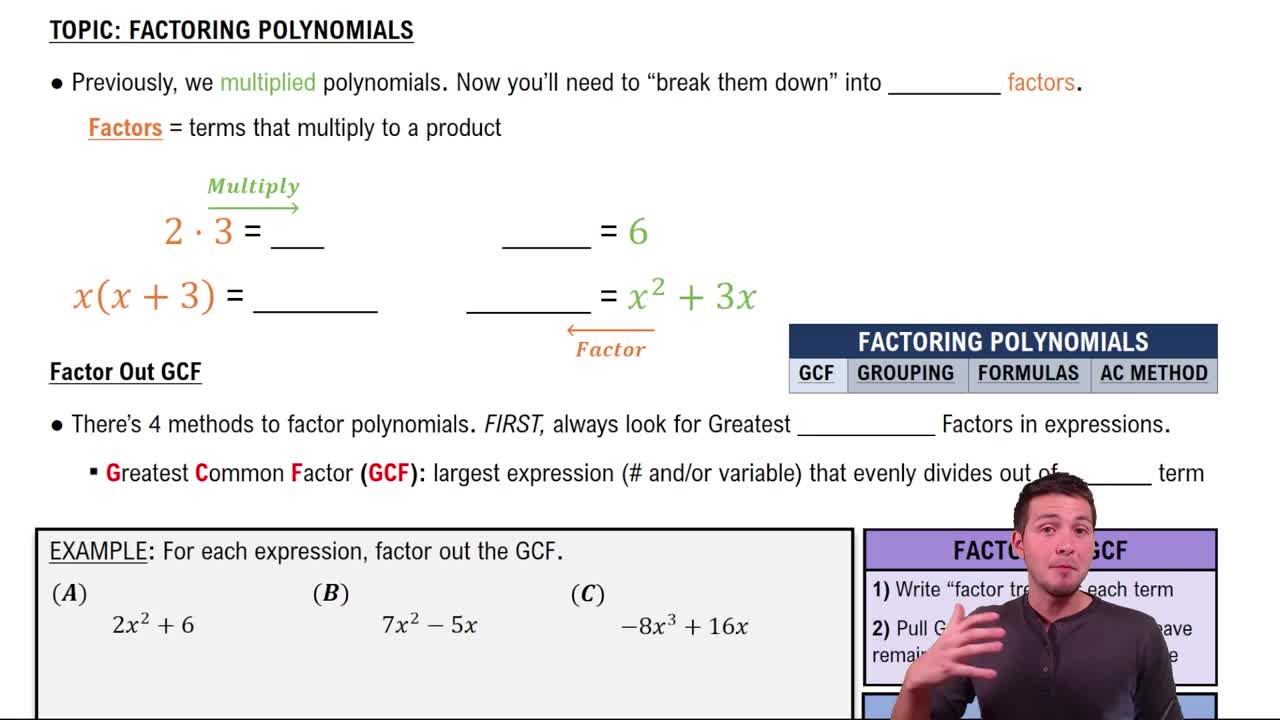
Factoring Polynomials Using Known Roots

Once a root is known, the polynomial can be divided by the corresponding factor (x - root) to reduce its degree. Repeated use of this process helps find all zeros by factoring the polynomial completely.
Recommended video:
Guided course
07:30
Introduction to Factoring Polynomials

Polynomial Division and Synthetic Division

Polynomial division, including synthetic division, is a method to divide polynomials by linear factors. It simplifies the polynomial after factoring out known roots, making it easier to find remaining zeros.
Recommended video:
Guided course
07:30
Introduction to Factoring Polynomials