Ch. R - Review of Basic Concepts
Lial - College Algebra 13th Edition
Lial13th EditionCollege AlgebraISBN: 9780136881063Not the one you use?Change textbook
Chapter 1, Problem 7

Let U = {1, 2, 3, 4, 5} and A = {1, 2, 3}. Find A′.

Verified step by step guidance
1
Identify the universal set \(U\) and the subset \(A\). Here, \(U = \{1, 2, 3, 4, 5\}\) and \(A = \{1, 2, 3\}\).
Recall that the complement of set \(A\), denoted \(A'\), consists of all elements in the universal set \(U\) that are not in \(A\).
List all elements of \(U\) that are not in \(A\). This means finding elements in \(U\) \(\textbackslash\) \(A\).
Write the complement set \(A'\) as \(A' = \{ x \in U : x \notin A \}\).
Express \(A'\) explicitly by listing the elements found in step 3.

Verified video answer for a similar problem:

This video solution was recommended by our tutors as helpful for the problem above.
Video duration:
1m
Was this helpful?

Key Concepts

Here are the essential concepts you must grasp in order to answer the question correctly.

Universal Set

The universal set, denoted by U, contains all elements under consideration in a particular context. It serves as the reference set for defining subsets and their complements. In this problem, U = {1, 2, 3, 4, 5} includes all elements relevant to the sets involved.
Recommended video:
05:18
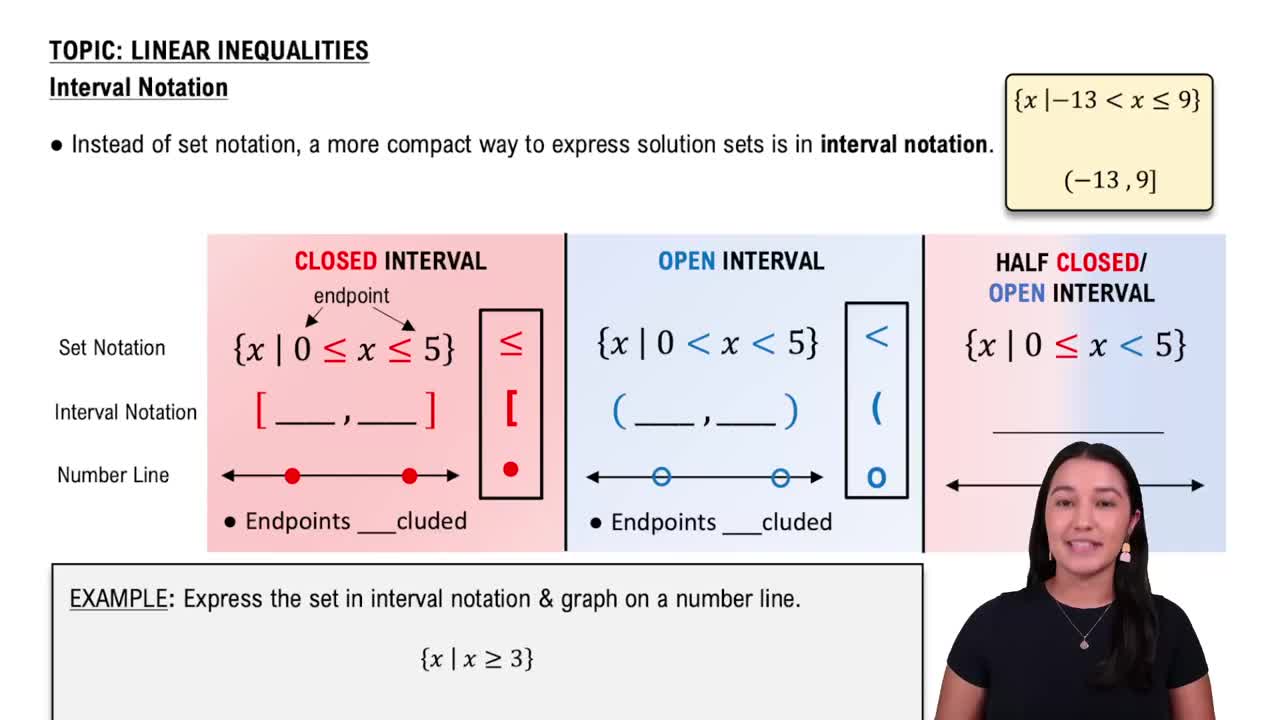
Interval Notation

Subset

A subset is a set whose elements are all contained within another set. Here, A = {1, 2, 3} is a subset of the universal set U. Understanding subsets helps in identifying which elements belong to a particular group within the universal set.

Complement of a Set

The complement of a set A, denoted A′, consists of all elements in the universal set U that are not in A. To find A′, subtract the elements of A from U. For example, if U = {1, 2, 3, 4, 5} and A = {1, 2, 3}, then A′ = {4, 5}.
Recommended video:
4:23
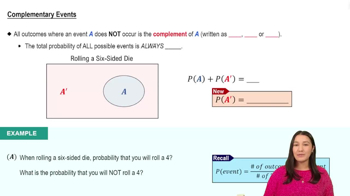
Complementary Events