Perform the indicated operations. Assume all variables represent positive real numbers. 8√(2x) - √(8x) + √(72x)
Ch. R - Review of Basic Concepts

Chapter 1, Problem 95
Evaluate each expression. (-2/9 -1/4) - {-5/18 - (-1/2)}
Verified step by step guidance1
First, simplify the expression inside the parentheses and the braces separately. Start with the first parentheses: \(\left(-\frac{2}{9} - \frac{1}{4}\right)\).
Find a common denominator for the fractions inside the first parentheses. The denominators are 9 and 4, so the least common denominator (LCD) is 36. Rewrite each fraction with denominator 36: \(-\frac{2}{9} = -\frac{8}{36}\) and \(-\frac{1}{4} = -\frac{9}{36}\).
Add the fractions inside the first parentheses: \(-\frac{8}{36} - \frac{9}{36} = -\frac{17}{36}\).
Next, simplify the expression inside the braces: \(\left\{-\frac{5}{18} - \left(-\frac{1}{2}\right)\right\}\). Remember that subtracting a negative is the same as adding a positive.
Rewrite \(-\frac{1}{2}\) as \(+\frac{1}{2}\) and find a common denominator for \(-\frac{5}{18}\) and \(+\frac{1}{2}\). The denominators are 18 and 2, so the LCD is 18. Convert \(\frac{1}{2}\) to \(\frac{9}{18}\), then add: \(-\frac{5}{18} + \frac{9}{18} = \frac{4}{18}\). Simplify if possible.

Verified video answer for a similar problem:
This video solution was recommended by our tutors as helpful for the problem above.
Video duration:
4mWas this helpful?
Key Concepts
Here are the essential concepts you must grasp in order to answer the question correctly.
Operations with Fractions
Understanding how to add, subtract, multiply, and divide fractions is essential. This includes finding common denominators to combine fractions and correctly handling negative signs to ensure accurate calculations.
Recommended video:
Guided course
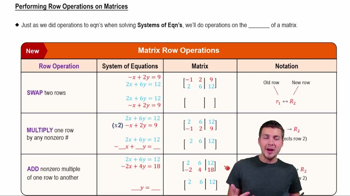
Performing Row Operations on Matrices
Order of Operations
Applying the correct order of operations (PEMDAS) is crucial when evaluating expressions. This means simplifying expressions inside parentheses or braces first, then performing addition or subtraction in the correct sequence.
Recommended video:
Guided course
Performing Row Operations on Matrices
Working with Negative Numbers
Handling negative numbers properly is important, especially when subtracting negative values, which involves changing signs. Recognizing that subtracting a negative is equivalent to adding a positive helps avoid common mistakes.
Recommended video:
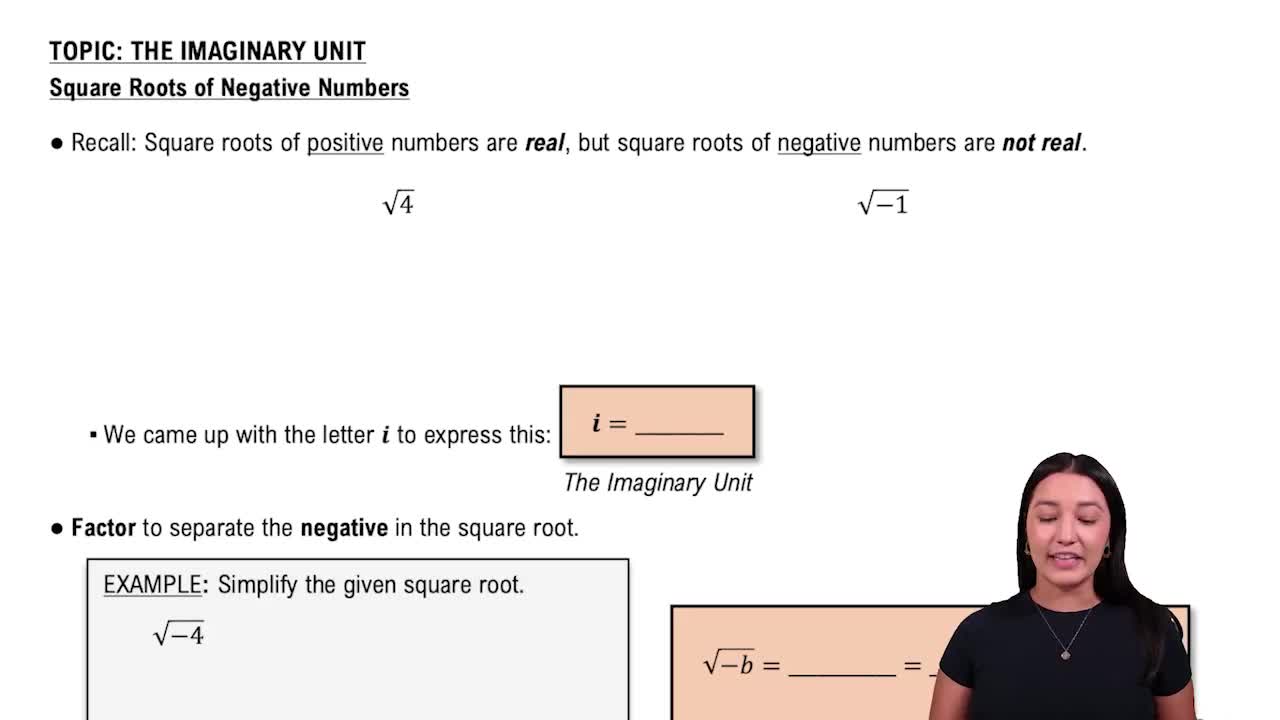
Square Roots of Negative Numbers
Related Practice
Textbook Question
1679
views
Textbook Question
Simplify each rational expression. Assume all variable expressions represent positive real numbers. (Hint: Use factoring and divide out any common factors as a first step.) [(x2 +1)4(2x) - x2(4)(x2+1)3(2x)] / [(x2+1)8]
483
views
Textbook Question
Simplify each expression. Write answers without negative exponents. Assume all variables represent positive real numbers. (y7/3)(y-4/3)
859
views
Textbook Question
Factor each polynomial. See Example 7.
1001
views
Textbook Question
Add or subtract as indicated. 28.73 - 3.12
973
views
Textbook Question
Let U = {0, 1, 2, 3, 4, 5, 6, 7, 8, 9, 10, 11, 12, 13}, M = {0, 2, 4, 6, 8}, N = {1, 3, 5, 7, 9, 11, 13}, Q = {0, 2, 4, 6, 8, 10, 12}, and R = {0, 1, 2, 3, 4}.Use these sets to find each of the following. Identify any disjoint sets. N ∪ ∅
933
views