Ch. 1 - Equations and Inequalities
Lial - College Algebra 13th Edition
Lial13th EditionCollege AlgebraISBN: 9780136881063Not the one you use?Change textbook
Chapter 2, Problem 98

Simplify each power of i. i-14

Verified step by step guidance
1
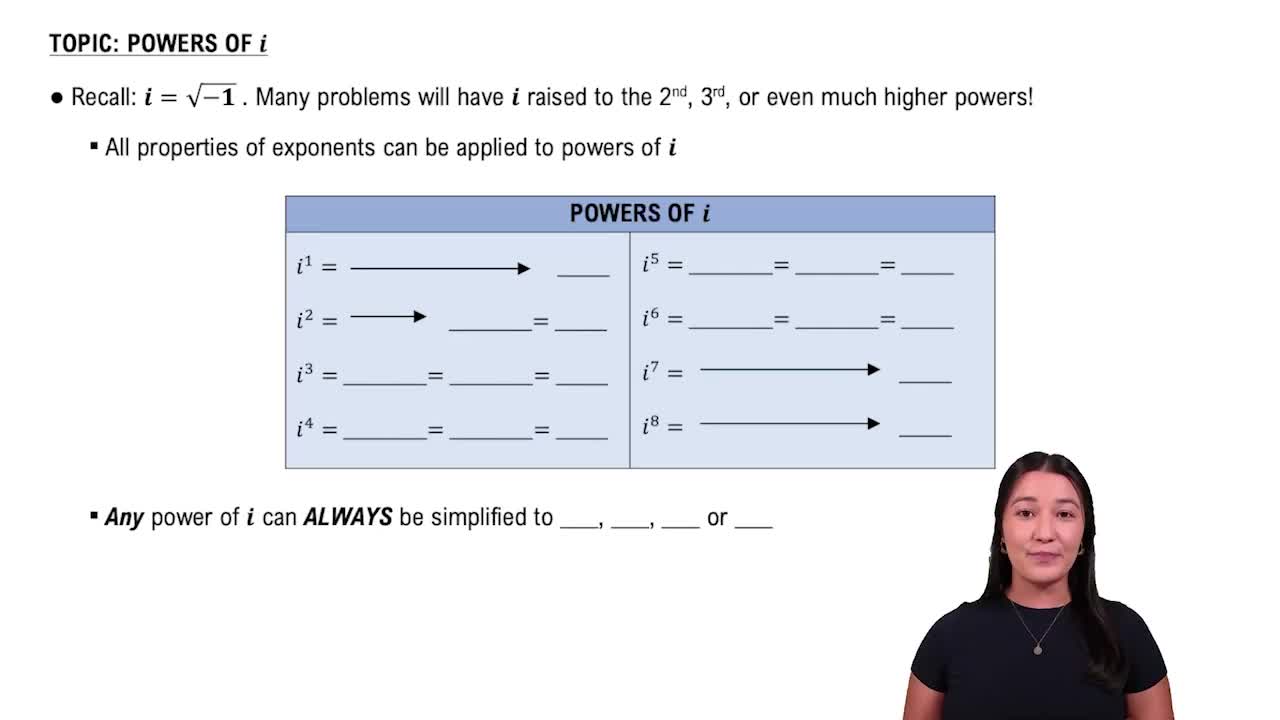
Recall that the imaginary unit \(i\) satisfies the property \(i^4 = 1\), which means powers of \(i\) repeat every 4 steps.
Rewrite the negative exponent using the property of exponents: \(i^{-14} = \frac{1}{i^{14}}\).
Simplify the denominator by reducing the exponent modulo 4: find the remainder when 14 is divided by 4, i.e., calculate \(14 \mod 4\).
Express \(i^{14}\) as \(i^{(4 \times 3) + 2} = (i^4)^3 \times i^2\), and since \(i^4 = 1\), this simplifies to \(1^3 \times i^2 = i^2\).
Substitute back to get \(i^{-14} = \frac{1}{i^2}\), and then simplify \(\frac{1}{i^2}\) using the fact that \(i^2 = -1\).

Verified video answer for a similar problem:

This video solution was recommended by our tutors as helpful for the problem above.
Video duration:
4m
Was this helpful?

Key Concepts

Here are the essential concepts you must grasp in order to answer the question correctly.

Imaginary Unit i

The imaginary unit i is defined as the square root of -1, satisfying i² = -1. It is the fundamental unit used to extend the real number system to complex numbers, allowing for the representation and manipulation of numbers involving the square roots of negative values.
Recommended video:
04:10
Powers of i

Powers of i and Their Cyclic Pattern

Powers of i follow a repeating cycle every four exponents: i¹ = i, i² = -1, i³ = -i, i⁴ = 1, and then the pattern repeats. This cyclicity helps simplify any integer power of i by reducing the exponent modulo 4.
Recommended video:
04:10
Powers of i

Negative Exponents

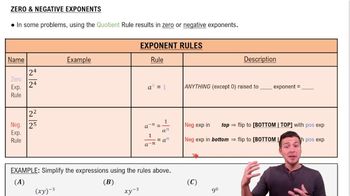
A negative exponent indicates the reciprocal of the base raised to the corresponding positive exponent, i.e., a⁻ⁿ = 1/aⁿ. Applying this to powers of i means i⁻¹ = 1/i, which can be further simplified using properties of complex numbers.
Recommended video:
Guided course
6:37
Zero and Negative Rules