Ch. 1 - Equations and Inequalities
Lial - College Algebra 13th Edition
Lial13th EditionCollege AlgebraISBN: 9780136881063Not the one you use?Change textbook
Chapter 2, Problem 71

Solve each equation. ∜(x-15)=2

Verified step by step guidance
1
Recognize that the equation involves a fourth root, which can be rewritten using exponents. The fourth root of an expression \(x - 15\) is the same as \((x - 15)^{\frac{1}{4}}\).
Rewrite the equation \(\sqrt[4]{x - 15} = 2\) as \((x - 15)^{\frac{1}{4}} = 2\).
To eliminate the fourth root, raise both sides of the equation to the power of 4, which gives \(\left((x - 15)^{\frac{1}{4}}\right)^4 = 2^4\).
Simplify the left side to \(x - 15\) and the right side to \(16\), resulting in the equation \(x - 15 = 16\).
Solve for \(x\) by adding 15 to both sides, giving \(x = 16 + 15\).

Verified video answer for a similar problem:

This video solution was recommended by our tutors as helpful for the problem above.
Video duration:
53s
Was this helpful?

Key Concepts

Here are the essential concepts you must grasp in order to answer the question correctly.

Radical Expressions and Roots

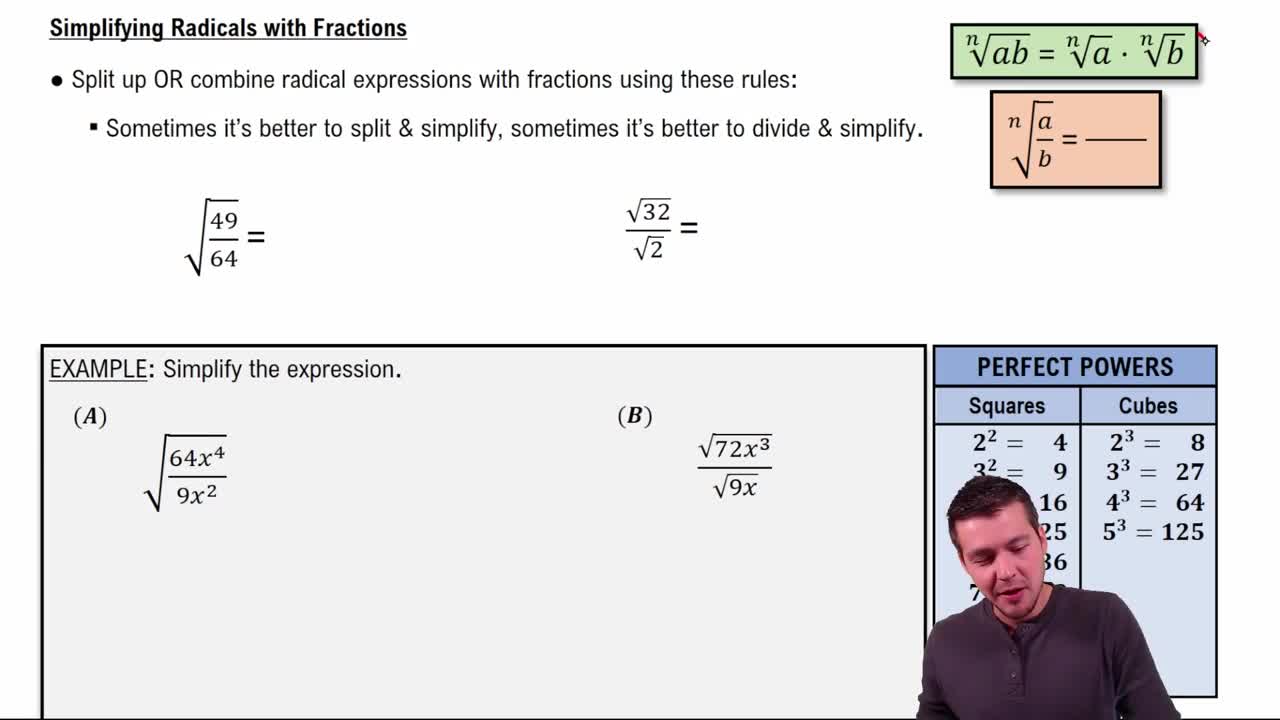
A radical expression involves roots such as square roots, cube roots, or fourth roots (∜). Understanding how to interpret and manipulate these roots is essential for solving equations involving radicals.
Recommended video:
Guided course
05:45
Radical Expressions with Fractions

Isolating the Variable

To solve the equation, first isolate the radical expression containing the variable. This step simplifies the equation and prepares it for eliminating the radical by raising both sides to the appropriate power.
Recommended video:
Guided course
05:28
Equations with Two Variables

Raising Both Sides to a Power

To eliminate a fourth root, raise both sides of the equation to the fourth power. This operation removes the radical, allowing you to solve the resulting polynomial equation for the variable.
Recommended video:
04:10
Powers of i