Ch. 5 - Systems and Matrices
Lial - College Algebra 13th Edition
Lial13th EditionCollege AlgebraISBN: 9780136881063Not the one you use?Change textbook
Chapter 6, Problem 15

Find the partial fraction decomposition for each rational expression. See Examples 1–4. (4x^2 - x - 15)/(x(x + 1)(x - 1))

Verified step by step guidance
1
Identify the form of the partial fraction decomposition based on the factors in the denominator. Since the denominator is \(x(x + 1)(x - 1)\), which consists of three distinct linear factors, the decomposition will be of the form: \(\frac{A}{x} + \frac{B}{x + 1} + \frac{C}{x - 1}\), where \(A\), \(B\), and \(C\) are constants to be determined.
Write the equation equating the original rational expression to the sum of the partial fractions: \(\frac{4x^{2} - x - 15}{x(x + 1)(x - 1)} = \frac{A}{x} + \frac{B}{x + 1} + \frac{C}{x - 1}\).
Multiply both sides of the equation by the common denominator \(x(x + 1)(x - 1)\) to clear the denominators, resulting in: \$4x^{2} - x - 15 = A(x + 1)(x - 1) + B x (x - 1) + C x (x + 1)$.
Expand each term on the right-hand side: - \(A(x + 1)(x - 1) = A(x^{2} - 1)\), - \(B x (x - 1) = B(x^{2} - x)\), - \(C x (x + 1) = C(x^{2} + x)\). Then combine like terms to express the right side as a polynomial in \(x\).
Set the coefficients of corresponding powers of \(x\) on both sides equal to each other to form a system of equations. Solve this system for \(A\), \(B\), and \(C\) to find the constants for the partial fraction decomposition.

Verified video answer for a similar problem:

This video solution was recommended by our tutors as helpful for the problem above.
Video duration:
13m
Was this helpful?

Key Concepts

Here are the essential concepts you must grasp in order to answer the question correctly.

Partial Fraction Decomposition

Partial fraction decomposition is a method used to express a complex rational expression as a sum of simpler fractions with linear or quadratic denominators. This technique simplifies integration and other algebraic operations by breaking down the original fraction into manageable parts.
Recommended video:
4:07
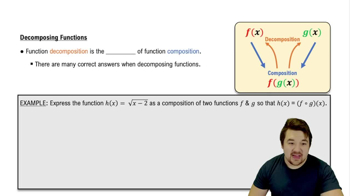
Decomposition of Functions

Factoring Polynomials

Factoring involves rewriting a polynomial as a product of its factors. In this problem, the denominator is already factored into linear terms x, (x + 1), and (x - 1), which is essential for setting up the partial fractions correctly.
Recommended video:
Guided course
07:30
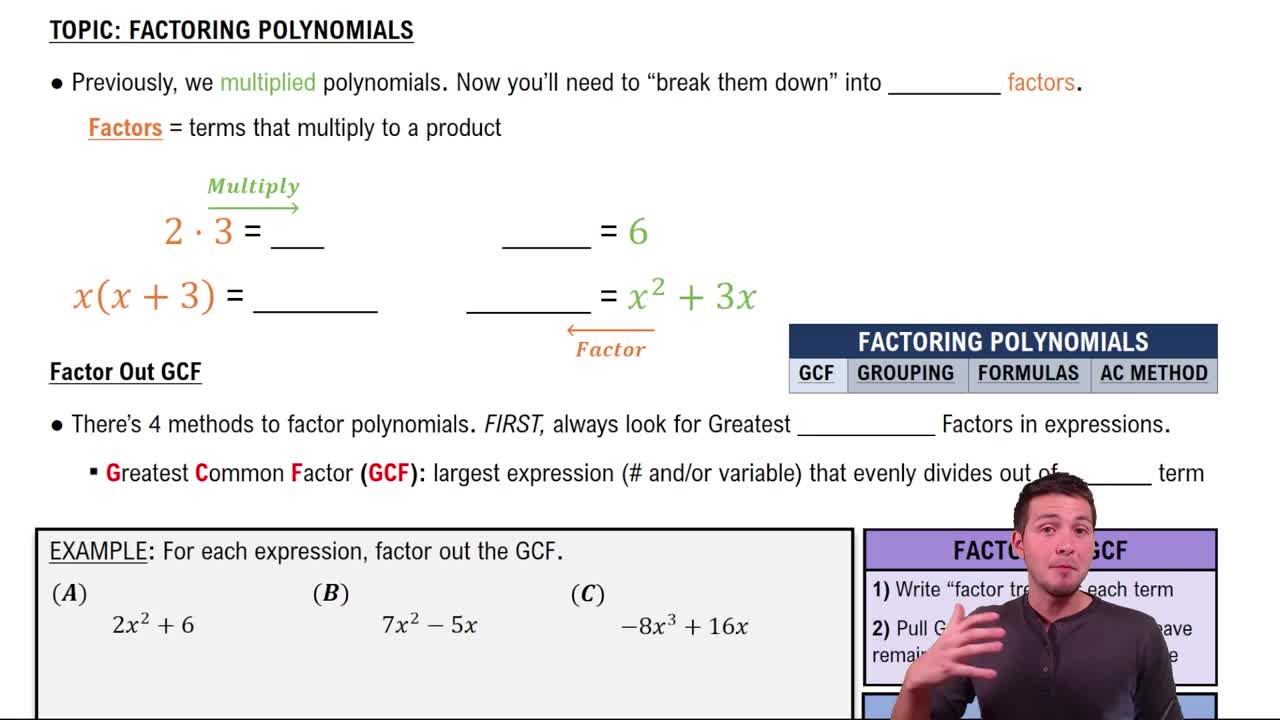
Introduction to Factoring Polynomials

Setting Up and Solving Systems of Equations

After expressing the rational expression as a sum of partial fractions with unknown coefficients, you multiply both sides by the common denominator and equate coefficients of corresponding powers of x. This process leads to a system of linear equations that must be solved to find the unknown constants.
Recommended video:
Guided course
5:48
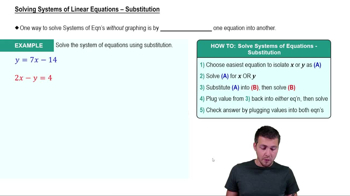
Solving Systems of Equations - Substitution