Factor out the greatest common factor from each polynomial. See Example 1.
Verified step by step guidance
1
Identify the greatest common factor (GCF) of the coefficients: look at the numbers 4, 8, and 12. Determine the largest number that divides all three evenly.
Find the GCF of the variable parts by looking at each variable's exponents across all terms. For variable \(k\), find the smallest exponent among \(k^2\), \(k^4\), and \(k^2\). For variable \(m\), find the smallest exponent among \(m^3\), \(m^3\), and \(m^4\).
Combine the GCF of the coefficients and the variables to write the overall GCF of the polynomial.
Divide each term of the polynomial by the GCF you found. This will give you the simplified terms inside the parentheses after factoring out the GCF.
Write the factored form as the GCF multiplied by the simplified polynomial inside parentheses: \(\text{GCF} \left( \text{simplified terms} \right)\).
Verified video answer for a similar problem:
This video solution was recommended by our tutors as helpful for the problem above
Video duration:
4m
Play a video:
0 Comments
Key Concepts
Here are the essential concepts you must grasp in order to answer the question correctly.
Greatest Common Factor (GCF)
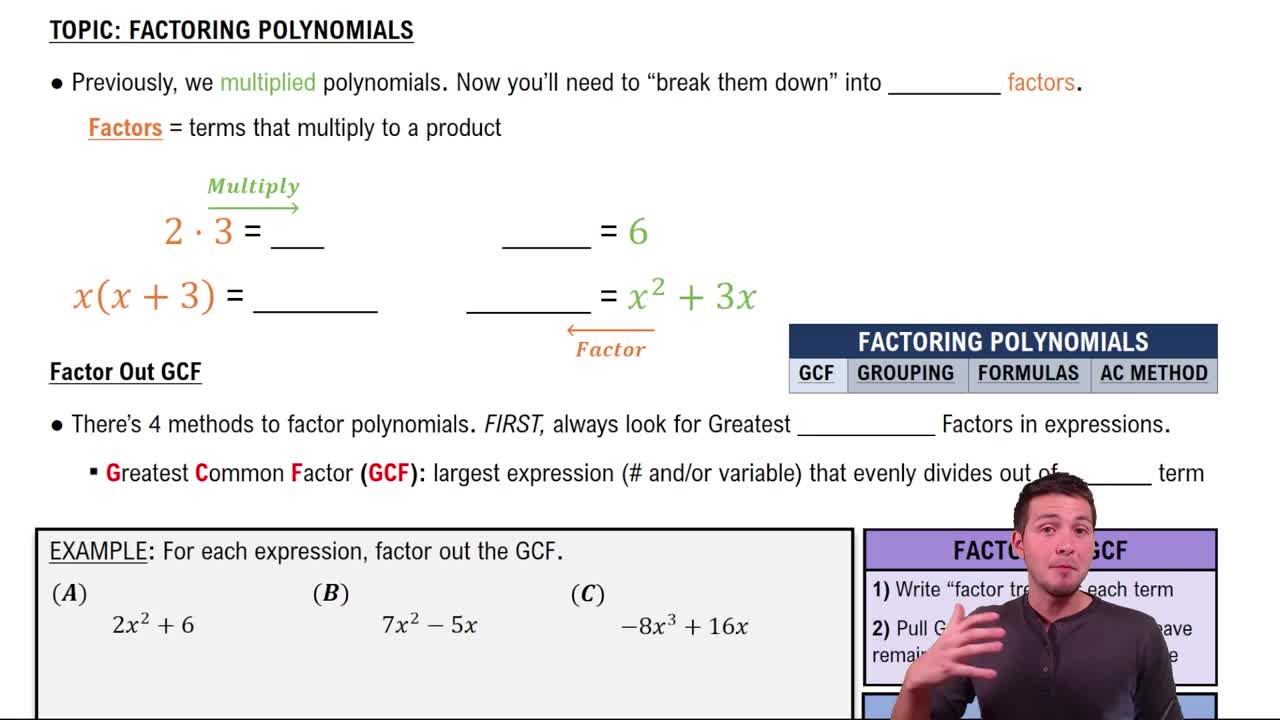
The Greatest Common Factor is the largest factor that divides two or more terms without leaving a remainder. In polynomials, it includes the highest power of variables and the largest numerical factor common to all terms. Factoring out the GCF simplifies the expression and is the first step in polynomial factorization.
Factoring polynomials involves rewriting the expression as a product of simpler polynomials or factors. Extracting the GCF is a fundamental factoring technique that reduces the polynomial to a simpler form, making it easier to solve or further factor if needed.
When factoring polynomials, understanding exponents is crucial. The GCF includes the variable raised to the smallest power present in all terms. For example, if terms have k^2 and k^4, the GCF includes k^2, the lower exponent, ensuring the factor is common to all terms.