Determine whether or not each metal dissolves in 1 M HNO3. For those metals that do dissolve, write a balanced redox reaction showing what happens when the metal dissolves. a. Cu b. Au
Ch.19 - Electrochemistry
Chapter 19, Problem 58
Determine whether or not each metal dissolves in 1 M HCl. For those metals that do dissolve, write a balanced redox reaction showing what happens when the metal dissolves. a. Cu b. Fe c. Au
Verified step by step guidance1
Step 1: Understand the reactivity series of metals. Metals that are above hydrogen in the reactivity series can displace hydrogen from acids like HCl, leading to dissolution.
Step 2: Identify the position of each metal (Cu, Fe, Au) in the reactivity series. Copper (Cu) and gold (Au) are below hydrogen, while iron (Fe) is above hydrogen.
Step 3: Determine which metals will dissolve in 1 M HCl. Since Fe is above hydrogen, it will dissolve in HCl, while Cu and Au will not.
Step 4: Write the balanced redox reaction for the metal that dissolves. For Fe, the reaction is: \[ \text{Fe (s)} + 2\text{HCl (aq)} \rightarrow \text{FeCl}_2\text{(aq)} + \text{H}_2\text{(g)} \].
Step 5: Verify the redox reaction by checking the oxidation states. Fe goes from 0 to +2 (oxidation), and H goes from +1 to 0 (reduction), confirming the redox process.
Key Concepts
Here are the essential concepts you must grasp in order to answer the question correctly.
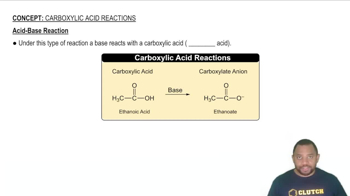
Acid-Base Reactions
Acid-base reactions involve the transfer of protons (H+) between reactants. In this context, hydrochloric acid (HCl) acts as a strong acid that can donate protons. Understanding how metals interact with acids is crucial for predicting whether a metal will dissolve in HCl, as some metals can displace hydrogen ions from the acid.
Recommended video:
Guided course
Acid-Base Reaction
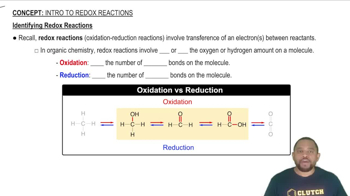
Redox Reactions
Redox (reduction-oxidation) reactions involve the transfer of electrons between substances, leading to changes in oxidation states. When a metal dissolves in an acid, it typically undergoes oxidation, losing electrons, while the hydrogen ions in the acid are reduced to hydrogen gas. Balancing these reactions requires understanding the electron transfer process and the oxidation states of the involved species.
Reactivity of Metals
The reactivity of metals determines their ability to dissolve in acids. Metals like iron (Fe) are more reactive and can displace hydrogen from acids, while less reactive metals like copper (Cu) and gold (Au) do not react with HCl. Knowing the reactivity series helps predict which metals will dissolve in HCl and allows for the formulation of balanced chemical equations for the reactions.
Recommended video:
Guided course
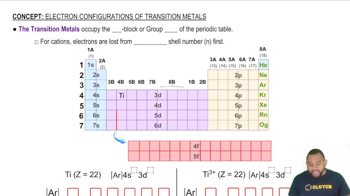
Transition Metals
Related Practice
Textbook Question
1263
views
1
rank
Textbook Question
Determine whether or not each metal dissolves in 1 M HCl. For those metals that do dissolve, write a balanced redox reaction showing what happens when the metal dissolves. a. Al b. Ag c. Pb
3515
views
6
rank
Textbook Question
Which metal could you use to reduce Mn2+ ions but not Mg2+ ions?
1002
views
Textbook Question
Which metal can be oxidized with an Sn2+ solution but not with an Fe2+ solution?
648
views
Textbook Question
Determine whether or not each metal dissolves in 1 M HIO3. For those metals that do dissolve, write a balanced redox equation for the reaction that occurs. a. Au b. Cr
1250
views
Textbook Question
Calculate E°cell for each balanced redox reaction and determine if the reaction is spontaneous as written. a. 2 Cu(s) + Mn2+(aq) → 2 Cu+(aq) + Mn(s)
1221
views