Back

Inheritance in Diploids and Haploids definitions

Control buttons has been changed to "navigation" mode.
1/15
  • Diploid

    A cell or organism with two sets of chromosomes, allowing for two alleles per gene and complex inheritance patterns.
  • Haploid

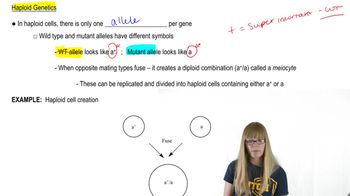
    A cell with a single set of chromosomes, containing only one allele per gene, simplifying genetic outcomes.
  • Allele

    A unique version of a gene, responsible for variations in a specific trait, present in pairs in diploids.
  • Dominant

    An allele whose trait is always expressed when present, masking the effect of other alleles at the same locus.
  • Recessive

    An allele whose trait is only expressed when both alleles are identical, remaining hidden if a dominant allele is present.
  • Homozygous

    A genetic condition where both alleles for a gene are identical, resulting in consistent trait expression.
  • Heterozygous

    A genetic state with two different alleles for a gene, often leading to dominant trait expression.
  • Locus

    A specific position on a chromosome where a gene is located, unique for each gene.
  • Chromosome

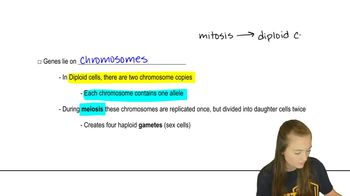
    A DNA structure carrying genes, varying in number and shape among species, and crucial for inheritance.
  • Homologous Pair

    Two chromosomes of the same type in a diploid cell, each carrying the same genes but possibly different alleles.
  • Sister Chromatid

    Genetically identical copies of a chromosome, formed during DNA replication and joined by a centromere.
  • Centromere

    A specialized DNA region on a chromosome that holds sister chromatids together and enables chromosome movement.
  • Meiosis

    A cell division process producing haploid gametes from diploid cells, involving two sequential divisions.
  • Wild Type

    The standard allele form in a population, denoted by a plus sign in haploid genetics.
  • Mutant

    An allele differing from the standard, lacking the plus sign in haploid notation, often resulting in altered traits.