Pearson+ LogoPearson+ Logo
Ch. 10 - Eukaryotic Chromosome Abnormalities and Molecular Organization
Sanders - Genetic Analysis: An Integrated Approach 3rd Edition
Sanders3rd EditionGenetic Analysis: An Integrated ApproachISBN: 9780135564172Not the one you use?Change textbook
Chapter 10, Problem 1e

Give descriptions for the following terms:
Euchromatin

Verified step by step guidance
1
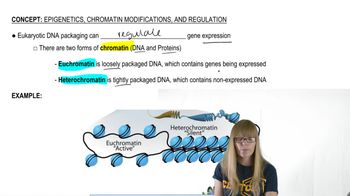
Euchromatin is a form of chromatin that is loosely packed and less condensed compared to heterochromatin, allowing for active transcription of genes.
It is typically found in regions of the genome that are transcriptionally active, meaning genes in euchromatin are accessible to RNA polymerase and other transcription machinery.
Euchromatin is rich in gene content and is often associated with histone modifications such as acetylation, which reduce the interaction between DNA and histones, promoting a more open chromatin structure.
Under a microscope, euchromatin appears lighter in staining compared to heterochromatin due to its less compact structure.
Euchromatin plays a critical role in gene expression regulation, as its open configuration allows for the binding of transcription factors and other regulatory proteins.

Verified video answer for a similar problem:

This video solution was recommended by our tutors as helpful for the problem above.
Video duration:
3m
Was this helpful?

Key Concepts

Here are the essential concepts you must grasp in order to answer the question correctly.

Euchromatin

Euchromatin is a form of chromatin that is less densely packed than heterochromatin, allowing for easier access to the DNA for transcription. It is typically found in regions of the genome that are actively being expressed, facilitating the synthesis of RNA and proteins. Euchromatin appears lighter under a microscope and is associated with gene-rich areas of the genome.
Recommended video:

Chromatin Structure

Chromatin is a complex of DNA and proteins that forms chromosomes within the nucleus of eukaryotic cells. It exists in two main forms: euchromatin and heterochromatin. The structure of chromatin plays a crucial role in regulating gene expression, DNA replication, and repair, as its compaction level influences the accessibility of the genetic material.
Recommended video:

Gene Expression

Gene expression is the process by which information from a gene is used to synthesize functional gene products, typically proteins. This process involves transcription of DNA into messenger RNA (mRNA) and subsequent translation of mRNA into proteins. The accessibility of euchromatin is vital for gene expression, as it allows transcription machinery to access the DNA sequence.
Recommended video:
Guided course
02:09
Penetrance and Expressivity