Pearson+ LogoPearson+ Logo
Ch. 10 - Eukaryotic Chromosome Abnormalities and Molecular Organization
Sanders - Genetic Analysis: An Integrated Approach 3rd Edition
Sanders3rd EditionGenetic Analysis: An Integrated ApproachISBN: 9780135564172Not the one you use?Change textbook
Chapter 10, Problem 1f

Give descriptions for the following terms:
Heterochromatin

Verified step by step guidance
1
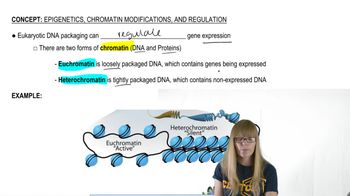
Heterochromatin refers to a tightly packed form of DNA, which is transcriptionally inactive or less active compared to euchromatin.
It is typically found in regions of the chromosome such as centromeres and telomeres, where gene expression is not required.
Heterochromatin can be classified into two types: constitutive heterochromatin, which is always condensed and contains repetitive sequences, and facultative heterochromatin, which can switch between condensed and relaxed states depending on the cell's needs.
The dense packing of heterochromatin is associated with specific histone modifications, such as methylation of histone H3 at lysine 9 (H3K9me), which helps maintain its repressive state.
Heterochromatin plays important roles in maintaining chromosome stability, regulating gene expression, and protecting the genome from transposable elements.

Verified video answer for a similar problem:

This video solution was recommended by our tutors as helpful for the problem above.
Video duration:
3m
Was this helpful?

Key Concepts

Here are the essential concepts you must grasp in order to answer the question correctly.

Heterochromatin

Heterochromatin is a tightly packed form of DNA that is generally transcriptionally inactive, meaning that genes located in these regions are not expressed. It plays a crucial role in maintaining the structural integrity of chromosomes and regulating gene expression. Heterochromatin can be found in two forms: constitutive, which is always in a compact state, and facultative, which can become more relaxed and active under certain conditions.
Recommended video:
Guided course
07:10
Chromosome Structure

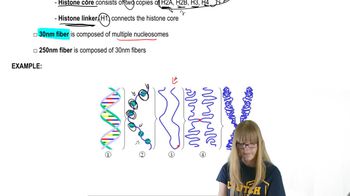
Chromatin Structure

Chromatin is the complex of DNA and proteins that forms chromosomes within the nucleus of eukaryotic cells. It exists in two forms: euchromatin, which is less condensed and actively involved in transcription, and heterochromatin, which is more condensed and generally inactive. The structure of chromatin is essential for DNA packaging, regulation of gene expression, and DNA replication.
Recommended video:

Gene Regulation

Gene regulation refers to the mechanisms that control the expression of genes, determining when and how much of a gene product is produced. Heterochromatin plays a significant role in gene regulation by silencing genes in its vicinity, thereby preventing their transcription. Understanding gene regulation is vital for comprehending how cells differentiate and respond to environmental signals.
Recommended video:
Guided course
09:22
Review of Regulation