Pearson+ LogoPearson+ Logo
Ch. 10 - Eukaryotic Chromosome Abnormalities and Molecular Organization
Sanders - Genetic Analysis: An Integrated Approach 3rd Edition
Sanders3rd EditionGenetic Analysis: An Integrated ApproachISBN: 9780135564172Not the one you use?Change textbook
Chapter 10, Problem 1a

Give descriptions for the following terms:
Histone proteins

Verified step by step guidance
1
Histone proteins are a group of highly alkaline proteins found in eukaryotic cell nuclei that package and order DNA into structural units called nucleosomes.
These proteins play a critical role in the organization of chromatin, which is the complex of DNA and protein that makes up chromosomes.
Histones are involved in gene regulation by controlling the accessibility of DNA to transcription factors and other regulatory proteins.
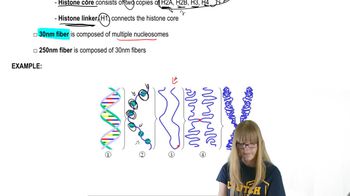
There are five main types of histone proteins: H1, H2A, H2B, H3, and H4. Histones H2A, H2B, H3, and H4 form the core of the nucleosome, while H1 is associated with the linker DNA between nucleosomes.
Histone modifications, such as acetylation, methylation, and phosphorylation, are key mechanisms for regulating gene expression and are studied in the field of epigenetics.

Verified video answer for a similar problem:

This video solution was recommended by our tutors as helpful for the problem above.
Video duration:
1m
Was this helpful?

Key Concepts

Here are the essential concepts you must grasp in order to answer the question correctly.

Histone Proteins

Histone proteins are highly alkaline proteins found in eukaryotic cell nuclei that package and order DNA into structural units called nucleosomes. They play a crucial role in the regulation of gene expression and DNA replication by controlling the accessibility of DNA to transcription factors and other proteins.
Recommended video:

Nucleosome Structure

A nucleosome consists of a segment of DNA wrapped around a core of histone proteins, forming a bead-like structure. This arrangement compacts the DNA, allowing it to fit within the cell nucleus while also playing a key role in gene regulation by influencing the accessibility of specific DNA regions to the transcription machinery.
Recommended video:
Guided course
07:10
Chromosome Structure

Epigenetic Regulation

Histone proteins are involved in epigenetic regulation, which refers to heritable changes in gene expression that do not involve alterations to the underlying DNA sequence. Modifications to histones, such as methylation or acetylation, can affect how tightly DNA is wound around histones, thereby influencing gene activity and cellular function.
Recommended video: