
Pearson+ LogoPearson+ Logo
Ch. 10 - Eukaryotic Chromosome Abnormalities and Molecular Organization
Sanders - Genetic Analysis: An Integrated Approach 3rd Edition
Sanders3rd EditionGenetic Analysis: An Integrated ApproachISBN: 9780135564172Not the one you use?Change textbook
Chapter 10, Problem 32g

A healthy couple with a history of three previous spontaneous abortions has just had a child with cri-du-chat syndrome, a disorder caused by a terminal deletion of chromosome 5. Their physician orders karyotype analysis of both parents and of the child. The karyotype results for chromosomes 5 and 12 are shown here. Do the karyotypes of the parents help explain the occurrence of the three previous spontaneous abortions? Explain.

Verified step by step guidance
1
Step 1: Understand the genetic basis of cri-du-chat syndrome. Cri-du-chat syndrome is caused by a terminal deletion on the short arm of chromosome 5 (5p). This deletion can occur spontaneously or be inherited from a parent with a chromosomal rearrangement.
Step 2: Analyze the karyotype results of the parents. Look for any structural abnormalities, such as balanced translocations, inversions, or other chromosomal rearrangements, particularly involving chromosomes 5 and 12. Balanced rearrangements in a parent can lead to unbalanced gametes during meiosis, which may explain recurrent spontaneous abortions.
Step 3: Examine the karyotype of the child. Confirm the presence of the terminal deletion on chromosome 5p that causes cri-du-chat syndrome. This deletion may have arisen de novo or could be related to a parental chromosomal rearrangement.
Step 4: Correlate the findings. If one or both parents have a balanced chromosomal rearrangement (e.g., a translocation involving chromosome 5), this could lead to unbalanced gametes, increasing the risk of spontaneous abortions and potentially explaining the genetic basis of the child’s condition.
Step 5: Conclude based on the evidence. If the karyotypes of the parents show no abnormalities, the cri-du-chat syndrome in the child is likely due to a de novo mutation. However, if a parental chromosomal rearrangement is identified, it provides a genetic explanation for both the spontaneous abortions and the child’s condition.

Verified video answer for a similar problem:

This video solution was recommended by our tutors as helpful for the problem above.
Video duration:
1m
Was this helpful?

Key Concepts

Here are the essential concepts you must grasp in order to answer the question correctly.

Karyotype Analysis

Karyotype analysis is a laboratory technique that examines the number and structure of chromosomes in an individual's cells. It can identify chromosomal abnormalities, such as deletions, duplications, or translocations, which may lead to genetic disorders or reproductive issues. In this case, analyzing the karyotypes of the parents and child can reveal whether chromosomal abnormalities contributed to the spontaneous abortions.
Recommended video:
Guided course
02:48
Chi Square Analysis

Cri-du-chat Syndrome

Cri-du-chat syndrome is a genetic disorder caused by a deletion of a portion of chromosome 5, leading to developmental delays, distinctive facial features, and a high-pitched cry resembling a cat's meow. Understanding this syndrome is crucial as it may indicate underlying genetic issues in the parents that could also relate to their history of spontaneous abortions, potentially due to chromosomal abnormalities.
Recommended video:
Guided course
09:31
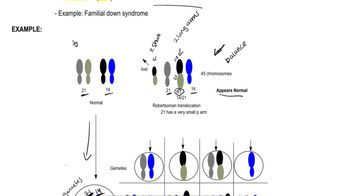
Robertsonian Translocations

Spontaneous Abortion and Genetic Factors

Spontaneous abortion, or miscarriage, often occurs due to genetic abnormalities in the fetus, which can arise from chromosomal issues in the parents. Factors such as balanced translocations or other chromosomal anomalies can lead to embryos that are not viable. Investigating the karyotypes of the parents may reveal such genetic factors that could explain the couple's history of miscarriages.
Recommended video:
Guided course
09:52
Spontaneous Mutations