Pearson+ LogoPearson+ Logo
Ch. 10 - Eukaryotic Chromosome Abnormalities and Molecular Organization
Sanders - Genetic Analysis: An Integrated Approach 3rd Edition
Sanders3rd EditionGenetic Analysis: An Integrated ApproachISBN: 9780135564172Not the one you use?Change textbook
Chapter 10, Problem 19

In humans that are XX/XO mosaics, the phenotype is highly variable, ranging from females who have classic Turner syndrome symptoms to females who are essentially normal. Likewise, XY/XO mosaics have phenotypes that range from Turner syndrome females to essentially normal males. How can the wide range of phenotypes be explained for these sex-chromosome mosaics?

Verified step by step guidance
1
span>Understand the concept of mosaicism: Mosaicism occurs when an individual has two or more populations of cells with different genotypes. In the case of XX/XO or XY/XO mosaics, some cells have two sex chromosomes (XX or XY), while others have only one (XO).
span>Consider the role of X chromosome inactivation: In females, one of the X chromosomes is randomly inactivated in each cell, a process known as X-inactivation. This can lead to variability in the expression of X-linked genes, contributing to phenotypic differences.
span>Examine the impact of the Y chromosome: In XY/XO mosaics, the presence or absence of the Y chromosome in certain cells can influence the development of male characteristics, leading to a range of phenotypes from Turner syndrome females to normal males.
span>Explore the influence of the proportion of XO cells: The ratio of XO to XX or XY cells can affect the severity of the phenotype. A higher proportion of XO cells may result in more pronounced Turner syndrome features, while a lower proportion may lead to milder symptoms or normal development.
span>Consider the role of genetic and environmental factors: Other genetic factors, such as mutations in autosomal genes, and environmental influences can also contribute to the variability in phenotypes observed in sex-chromosome mosaics.

Verified video answer for a similar problem:

This video solution was recommended by our tutors as helpful for the problem above.
Video duration:
2m
Was this helpful?

Key Concepts

Here are the essential concepts you must grasp in order to answer the question correctly.

Mosaicism

Mosaicism refers to the presence of two or more genetically different cell lines within an individual, resulting from mutations or chromosomal abnormalities during early development. In the context of sex-chromosome mosaics, this means that some cells may have different combinations of sex chromosomes, leading to a variety of phenotypes. This variability can significantly affect physical traits and health outcomes.
Recommended video:
Guided course
08:30
Genetics of Development

Turner Syndrome

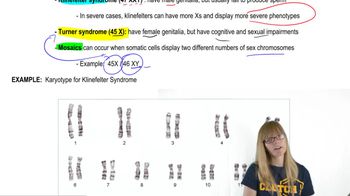
Turner syndrome is a genetic condition that occurs in females who have only one X chromosome (45,X) or a partial X chromosome. It is characterized by features such as short stature, delayed puberty, and infertility. In mosaic cases, some cells may have the typical XX configuration, while others may have the XO configuration, leading to a spectrum of symptoms and phenotypes, from classic Turner syndrome to normal female characteristics.
Recommended video:
Guided course
10:35
Human Sex Chromosomes

Phenotypic Variability

Phenotypic variability refers to the range of observable traits or characteristics that can arise from a single genotype due to environmental influences, genetic interactions, or developmental factors. In sex-chromosome mosaics, the differing combinations of sex chromosomes in various cell lines can lead to a wide array of phenotypes, as some cells may express traits associated with one sex while others may not, resulting in a complex interplay of characteristics.
Recommended video:
Guided course
10:48
Mutations and Phenotypes
Related Practice
Textbook Question

The accompanying chromosome diagram represents a eukaryotic chromosome prepared with Giemsa stain. Indicate the heterochromatic and euchromatic regions of the chromosome, and label the chromosome's centromeric and telomeric regions.

Are you more likely to find the DNA sequence encoding the digestive enzyme amylase in a heterochromatic, euchromatic, centromeric, or telomeric region? Explain your reasoning.

561
views
Textbook Question

Histone protein H4 isolated from pea plants and cow thymus glands contains 102 amino acids in both cases. A total of 100 of the amino acids are identical between the two species. Give an evolutionary explanation for this strong amino acid sequence identity based on what you know about the functions of histones and nucleosomes.

475
views
Textbook Question

A survey of organisms living deep in the ocean reveals two new species whose DNA is isolated for analysis. DNA samples from both species are treated to remove nonhistone proteins. Each DNA sample is then treated with DNase I that cuts DNA not protected by histone proteins but is unable to cut DNA bound by histone proteins. Following DNase I treatment, DNA samples are subjected to gel electrophoresis, and the gels are stained to visualize all DNA bands in the gel. The staining patterns of DNA bands from each species are shown in the figure. The number of base pairs in small DNA fragments is shown at the left of the gel. Interpret the gel results in terms of chromatin organization and the spacing of nucleosomes in the chromatin of each species.

450
views
Textbook Question

A plant breeder would like to develop a seedless variety of cucumber from two existing lines. Line A is a tetraploid line, and line B is a diploid line. Describe the breeding strategy that will produce a seedless line, and support your strategy by describing the results of crosses.

484
views
Textbook Question

In Drosophila, seven partial deletions (1 to 7) shown as gaps in the following diagram have been mapped on a chromosome. This region of the chromosome contains genes that express seven recessive mutant phenotypes, identified in the following table as a through g. A researcher wants to determine the location and order of genes on the chromosome, so he sets up a series of crosses in which flies homozygous for a mutant allele are crossed with flies homozygous for a partial deletion. The progeny are scored to determine whether they have the mutant phenotype ('m' in the table) or the wild-type phenotype ('+' in the table). Use the partial deletion map and the table of progeny phenotypes to determine the order of genes on the chromosome.

633
views
Textbook Question

Two experimental varieties of strawberry are produced by crossing a hexaploid line that contains 48 chromosomes and a tetraploid line that contains 32 chromosomes. Experimental variety 1 contains 40 chromosomes, and experimental variety 2 contains 56 chromosomes.

Do you expect both experimental lines to be fertile? Why or why not?

502
views