Pearson+ LogoPearson+ Logo
Ch. 10 - Eukaryotic Chromosome Abnormalities and Molecular Organization
Sanders - Genetic Analysis: An Integrated Approach 3rd Edition
Sanders3rd EditionGenetic Analysis: An Integrated ApproachISBN: 9780135564172Not the one you use?Change textbook
Chapter 10, Problem 11

In what way does position effect variegation (PEV) of Drosophila eye color indicate that chromatin state can affect gene transcription?

Verified step by step guidance
1
Understand that Position Effect Variegation (PEV) occurs when a gene normally located in euchromatin is relocated near heterochromatin due to chromosomal rearrangement, such as an inversion or translocation.
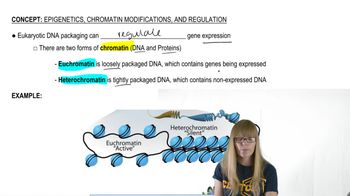
Recognize that heterochromatin is a tightly packed form of chromatin that is generally transcriptionally inactive, while euchromatin is loosely packed and transcriptionally active.
Analyze how the proximity of the eye color gene to heterochromatin causes variable silencing of the gene in different cells, leading to a mosaic or variegated eye color phenotype in Drosophila.
Interpret this variegation as evidence that the chromatin state (heterochromatin vs. euchromatin) can influence whether a gene is transcribed or silenced, demonstrating an epigenetic regulation mechanism.
Conclude that PEV shows gene expression is not solely determined by DNA sequence but also by the chromatin environment surrounding the gene, affecting accessibility to transcription machinery.

Verified video answer for a similar problem:

This video solution was recommended by our tutors as helpful for the problem above.
Video duration:
4m
Was this helpful?

Key Concepts

Here are the essential concepts you must grasp in order to answer the question correctly.

Position Effect Variegation (PEV)

PEV occurs when a gene normally located in euchromatin is relocated near heterochromatin due to chromosomal rearrangement, causing variable gene expression. In Drosophila, this leads to mosaic eye color patterns, demonstrating that gene activity can be influenced by its chromosomal position.
Recommended video:
Guided course
07:
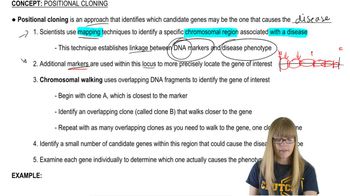
Positional Cloning

Chromatin States: Euchromatin vs. Heterochromatin

Euchromatin is loosely packed chromatin associated with active gene transcription, while heterochromatin is tightly packed and generally transcriptionally silent. The spread of heterochromatin into adjacent regions can silence genes, showing how chromatin structure regulates gene expression.
Recommended video:

Gene Transcription Regulation by Chromatin Environment

The chromatin environment affects accessibility of transcription machinery to DNA. When a gene is near heterochromatin, its transcription can be repressed due to reduced accessibility, illustrating that chromatin modifications and positioning play a critical role in controlling gene expression.
Recommended video:
Related Practice
Textbook Question

Mating between a male donkey (2n = 62) and a female horse (2n = 64) produces sterile mules. Recently, however, a very rare event occurred—a female mule gave birth to an offspring by mating with a horse.

Why is it very unlikely that the offspring will have fully horse-like genetic characteristics?

793
views
Textbook Question

A researcher interested in studying a human gene on chromosome 21 and another gene on the X chromosome uses FISH probes to locate each gene. The chromosome 21 probe produces green fluorescent color, and the X chromosome probe produces red fluorescent color.

If the subject studied is female, how many green and red spots will be detected? Explain your answer.

489
views
Textbook Question

A researcher interested in studying a human gene on chromosome 21 and another gene on the X chromosome uses FISH probes to locate each gene. The chromosome 21 probe produces green fluorescent color, and the X chromosome probe produces red fluorescent color.

If the subject studied is male, how many green and red spots will be detected? Explain your answer.

476
views
Textbook Question

A pair of homologous chromosomes in Drosophila has the following content (single letters represent genes):

Chromosome 1RNMDHBGKWU

Chromosome 2RNMDHBDHBGKWU

What term best describes this situation?

545
views
Textbook Question

A pair of homologous chromosomes in Drosophila has the following content (single letters represent genes):

Chromosome 1RNMDHBGKWU

Chromosome 2RNMDHBDHBGKWU

Diagram the pairing of these homologous chromosomes in prophase I.

383
views
Textbook Question

A pair of homologous chromosomes in Drosophila has the following content (single letters represent genes):

Chromosome 1RNMDHBGKWU

Chromosome 2RNMDHBDHBGKWU

What term best describes the unusual structure that forms during pairing of these chromosomes?

431
views