A normal chromosome and its homolog carrying a paracentric inversion are shown here. The dot (·) represents the centromere.
Normal ABC • DEFGHIJK
Inversion abc • djihgfe
Diagram the alignment of chromosomes during prophase I.

Sanders 3rd Edition
Ch. 10 - Eukaryotic Chromosome Abnormalities and Molecular Organization
Problem 16a
Verified step by step guidance
A normal chromosome and its homolog carrying a paracentric inversion are shown here. The dot (·) represents the centromere.
Normal ABC • DEFGHIJK
Inversion abc • djihgfe
Diagram the alignment of chromosomes during prophase I.
A normal chromosome and its homolog carrying a paracentric inversion are shown here. The dot (·) represents the centromere.
Normal ABC • DEFGHIJK
Inversion abc • djihgfe
Assume a crossover takes place in the region between F and G. Identify the gametes that are formed following this crossover, and indicate which, if any, gametes are viable.
A normal chromosome and its homolog carrying a paracentric inversion are shown here. The dot (·) represents the centromere.
Normal ABC • DEFGHIJK
Inversion abc • djihgfe
Assume a crossover takes place in the region between A and B. Identify the gametes that are formed by this crossover event, and indicate which, if any, gametes are viable.
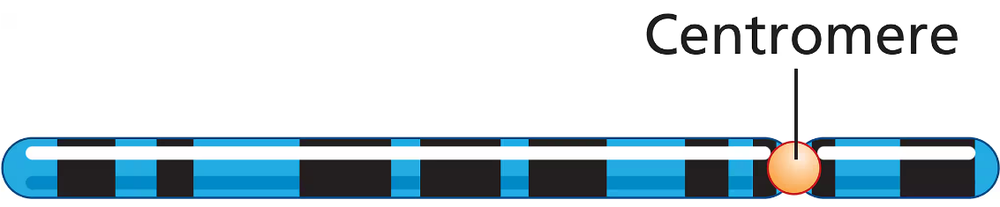
The accompanying chromosome diagram represents a eukaryotic chromosome prepared with Giemsa stain. Indicate the heterochromatic and euchromatic regions of the chromosome, and label the chromosome's centromeric and telomeric regions.
Do you expect the centromeric region to contain heterochromatin? Why or why not?
The accompanying chromosome diagram represents a eukaryotic chromosome prepared with Giemsa stain. Indicate the heterochromatic and euchromatic regions of the chromosome, and label the chromosome's centromeric and telomeric regions.
Why are expressed genes not found in the telomeric region of chromosomes?
The accompanying chromosome diagram represents a eukaryotic chromosome prepared with Giemsa stain. Indicate the heterochromatic and euchromatic regions of the chromosome, and label the chromosome's centromeric and telomeric regions.
Are you more likely to find the DNA sequence encoding the digestive enzyme amylase in a heterochromatic, euchromatic, centromeric, or telomeric region? Explain your reasoning.