Pearson+ LogoPearson+ Logo
Ch. 10 - Eukaryotic Chromosome Abnormalities and Molecular Organization
Sanders - Genetic Analysis: An Integrated Approach 3rd Edition
Sanders3rd EditionGenetic Analysis: An Integrated ApproachISBN: 9780135564172Not the one you use?Change textbook
Chapter 10, Problem B.11b

The most common reason a physician might recommend that a woman have maternal serum screening and a karyotype analysis is concern that her fetus may have Down syndrome. Go to the OMIM website at www.ncbi.nlm.nih.gov/omim and look up Down syndrome (OMIM 190685).
Look at the 'Mapping' and 'Molecular Genetics' sections and describe what is meant by the Down syndrome critical region (DSCR).

Verified step by step guidance
1
Begin by understanding that Down syndrome is a genetic disorder caused primarily by the presence of an extra copy of chromosome 21, known as trisomy 21.
Visit the OMIM website and search for the entry with the identifier 190685, which corresponds to Down syndrome, to access detailed genetic information.
Locate the 'Mapping' section on the OMIM page to find information about the specific regions on chromosome 21 that are associated with the features of Down syndrome.
Next, read the 'Molecular Genetics' section to understand the concept of the Down syndrome critical region (DSCR), which refers to a specific segment of chromosome 21 believed to contain the genes most responsible for the characteristic traits of Down syndrome.
Summarize that the DSCR is a defined portion of chromosome 21 where gene dosage imbalance (due to trisomy) leads to the phenotypic manifestations of Down syndrome, highlighting its importance in research and diagnosis.

Verified video answer for a similar problem:

This video solution was recommended by our tutors as helpful for the problem above.
Video duration:
1m
Was this helpful?

Key Concepts

Here are the essential concepts you must grasp in order to answer the question correctly.

Down Syndrome and Its Genetic Basis

Down syndrome is a genetic disorder caused primarily by trisomy of chromosome 21, leading to intellectual disability and characteristic physical features. Understanding its genetic basis involves recognizing that an extra copy of chromosome 21 disrupts normal development, which is why prenatal screening and karyotyping are used to detect this condition.
Recommended video:
Guided course
08:44
Genetics Basics

Down Syndrome Critical Region (DSCR)

The Down Syndrome Critical Region (DSCR) is a specific segment on chromosome 21 believed to contain genes responsible for many of the features of Down syndrome. Identifying this region helps researchers focus on key genes whose overexpression contributes to the syndrome’s phenotype, aiding in understanding and potential therapies.
Recommended video:
Guided course
09:31
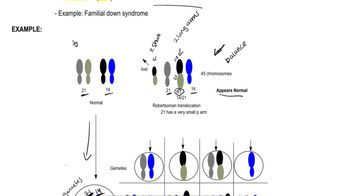
Robertsonian Translocations

Maternal Serum Screening and Karyotype Analysis

Maternal serum screening measures specific proteins and hormones in a pregnant woman's blood to assess the risk of chromosomal abnormalities like Down syndrome. Karyotype analysis involves examining fetal chromosomes directly to confirm the presence of trisomy 21, providing a definitive diagnosis.
Recommended video:
Guided course
03:38
Maternal Effect