Pearson+ LogoPearson+ Logo
Ch. 12 - Regulation of Gene Expression in Bacteria and Bacteriophage
Sanders - Genetic Analysis: An Integrated Approach 3rd Edition
Sanders3rd EditionGenetic Analysis: An Integrated ApproachISBN: 9780135564172Not the one you use?Change textbook
Chapter 12, Problem 1

Bacterial genomes frequently contain groups of genes organized into operons. What is the biological advantage of operons to bacteria? Identify the regulatory components you would expect to find in an operon. How are the expressed genes of an operon usually arranged?

Verified step by step guidance
1
Understand that an operon is a cluster of genes under the control of a single promoter and regulatory elements, allowing coordinated expression of genes with related functions.
Explain the biological advantage: operons enable bacteria to efficiently regulate multiple genes simultaneously, conserving energy by expressing genes only when needed.
Identify the key regulatory components of an operon, which typically include the promoter (where RNA polymerase binds), the operator (a DNA segment where repressors or activators bind), and structural genes (coding for proteins).
Describe how regulatory proteins such as repressors or activators interact with the operator to control transcription of the operon genes in response to environmental signals.
Note that the expressed genes in an operon are usually arranged sequentially and transcribed together into a single polycistronic mRNA, allowing coordinated translation of all gene products.

Verified video answer for a similar problem:

This video solution was recommended by our tutors as helpful for the problem above.
Video duration:
1m
Was this helpful?

Key Concepts

Here are the essential concepts you must grasp in order to answer the question correctly.

Operons in Bacterial Genomes

An operon is a cluster of genes under the control of a single promoter and regulatory elements, allowing coordinated expression. This organization enables bacteria to efficiently regulate genes with related functions, often involved in the same metabolic pathway, ensuring resources are conserved and responses are rapid.
Recommended video:
Guided course
03:45
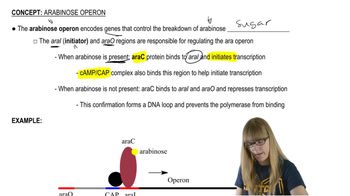
Arabinose Operon

Regulatory Components of an Operon

Key regulatory components of an operon include the promoter, where RNA polymerase binds to initiate transcription; the operator, a DNA segment where repressors or activators bind to control gene expression; and regulatory genes that produce these proteins. These elements work together to turn gene expression on or off in response to environmental signals.
Recommended video:
Guided course
03:45
Arabinose Operon

Gene Arrangement and Expression in Operons

Genes within an operon are typically arranged sequentially and transcribed together into a single polycistronic mRNA. This arrangement ensures that all genes involved in a specific function are expressed simultaneously and in the correct stoichiometric ratios, facilitating coordinated protein production.
Recommended video:
Guided course
02:09
Penetrance and Expressivity