Bacterial genomes frequently contain groups of genes organized into operons. What is the biological advantage of operons to bacteria? Identify the regulatory components you would expect to find in an operon. How are the expressed genes of an operon usually arranged?
Ch. 12 - Regulation of Gene Expression in Bacteria and Bacteriophage

Sanders3rd EditionGenetic Analysis: An Integrated ApproachISBN: 9780135564172Not the one you use?Change textbook
All textbooks
Sanders 3rd Edition
Ch. 12 - Regulation of Gene Expression in Bacteria and Bacteriophage
Problem 2a
Sanders 3rd Edition
Ch. 12 - Regulation of Gene Expression in Bacteria and Bacteriophage
Problem 2aChapter 12, Problem 2a
Transcriptional regulation of operon gene expression involves the interaction of molecules with one another and of regulatory molecules with segments of DNA. In this context, define and give an example of each of the following:
Operator
Verified step by step guidance1
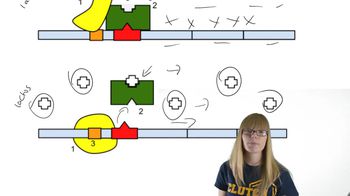
Understand the concept of an operator: An operator is a specific DNA sequence within an operon that acts as a regulatory element. It is the binding site for regulatory proteins, such as repressors or activators, which control the transcription of the genes in the operon.
Explain the role of the operator in transcriptional regulation: When a repressor protein binds to the operator, it blocks RNA polymerase from transcribing the downstream genes. Conversely, when an activator protein binds, it can enhance the binding of RNA polymerase, promoting transcription.
Provide an example of an operator: In the lac operon of *Escherichia coli*, the operator (lacO) is the DNA sequence where the lac repressor protein (LacI) binds. When lactose is absent, LacI binds to the operator, preventing transcription of the genes involved in lactose metabolism.
Discuss the interaction between the operator and regulatory molecules: The binding of regulatory proteins to the operator is often influenced by small molecules. For example, in the lac operon, the presence of allolactose (a lactose derivative) causes the repressor to release from the operator, allowing transcription to proceed.
Summarize the importance of the operator: The operator is a critical control point in gene expression, ensuring that the genes in an operon are transcribed only when needed, thereby conserving cellular resources and energy.

Verified video answer for a similar problem:
This video solution was recommended by our tutors as helpful for the problem above.
Video duration:
2mWas this helpful?
Key Concepts
Here are the essential concepts you must grasp in order to answer the question correctly.
Operator
An operator is a segment of DNA that a repressor protein binds to, inhibiting the transcription of adjacent genes. It acts as a regulatory switch in operons, controlling gene expression in response to environmental signals. For example, in the lac operon of E. coli, the operator is where the lac repressor binds, preventing transcription of genes involved in lactose metabolism when lactose is absent.
Recommended video:
Guided course
Lac Operon Regulation
Operon
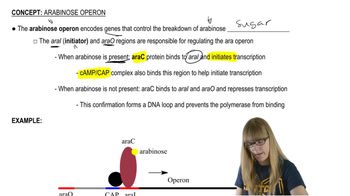
An operon is a cluster of genes under the control of a single promoter and regulated together, allowing coordinated expression. This arrangement is common in prokaryotes, enabling them to efficiently respond to changes in their environment. The lac operon, which includes genes for lactose utilization, is a classic example, illustrating how bacteria can adapt their metabolism based on available nutrients.
Recommended video:
Guided course
Arabinose Operon
Transcriptional Regulation
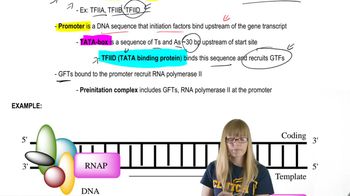
Transcriptional regulation refers to the mechanisms that control the transcription of genes, determining when and how much of a gene product is made. This regulation is crucial for cellular function and adaptation, involving various proteins, such as transcription factors and repressors, that interact with DNA sequences like promoters and operators. It allows cells to respond dynamically to internal and external stimuli, ensuring efficient resource use.
Recommended video:
Guided course
Eukaryotic Transcription
Related Practice
Textbook Question
1007
views
Textbook Question
Transcriptional regulation of operon gene expression involves the interaction of molecules with one another and of regulatory molecules with segments of DNA. In this context, define and give an example of each of the following:
Repressor
763
views
Textbook Question
Transcriptional regulation of operon gene expression involves the interaction of molecules with one another and of regulatory molecules with segments of DNA. In this context, define and give an example of each of the following:
Inducer
976
views
Textbook Question
Transcriptional regulation of operon gene expression involves the interaction of molecules with one another and of regulatory molecules with segments of DNA. In this context, define and give an example of each of the following:
Corepressor
551
views