Pearson+ LogoPearson+ Logo
Ch. 12 - Regulation of Gene Expression in Bacteria and Bacteriophage
Sanders - Genetic Analysis: An Integrated Approach 3rd Edition
Sanders3rd EditionGenetic Analysis: An Integrated ApproachISBN: 9780135564172Not the one you use?Change textbook
Chapter 12, Problem 30a

For an E. coli strain with the lac operon genotype I⁺ P⁺ O⁺ Z⁺ Y⁺, identify the level of transcription of the operon genes in each growth medium listed. Specify transcription as 'none,' 'basal,' or 'activated' for each medium, and provide an explanation to justify your answer.
Growth medium contains lactose and glucose.

Verified step by step guidance
1
Understand the lac operon genotype: The given genotype I⁺ P⁺ O⁺ Z⁺ Y⁺ indicates that the lac operon is wild-type. This means the repressor protein (I⁺), promoter (P⁺), operator (O⁺), and structural genes (Z⁺ for β-galactosidase and Y⁺ for permease) are all functional.
Analyze the growth medium: The medium contains both lactose and glucose. Lactose is an inducer of the lac operon, while glucose inhibits the operon through catabolite repression (via the cAMP-CRP complex).
Determine the effect of glucose: When glucose is present, the intracellular cAMP levels are low. This prevents the formation of the cAMP-CRP complex, which is required for the activation of the lac operon. As a result, transcription will not be activated, even if lactose is present.
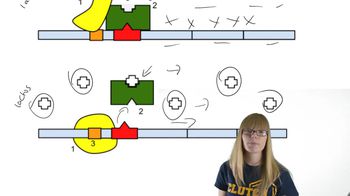
Determine the effect of lactose: Lactose binds to the repressor protein (produced by the I⁺ gene), causing it to change shape and release from the operator (O⁺). This allows RNA polymerase to bind to the promoter (P⁺) and initiate transcription at a basal level, as activation by the cAMP-CRP complex is inhibited by glucose.
Conclude the transcription level: In the presence of both lactose and glucose, the lac operon will be transcribed at a 'basal' level due to the absence of activation by the cAMP-CRP complex and the removal of repression by lactose.

Verified video answer for a similar problem:

This video solution was recommended by our tutors as helpful for the problem above.
Video duration:
3m
Was this helpful?

Key Concepts

Here are the essential concepts you must grasp in order to answer the question correctly.

Lac Operon Structure

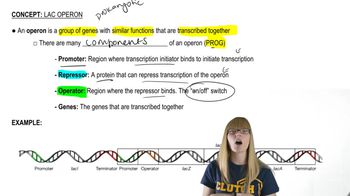
The lac operon in E. coli consists of several key components: the promoter (P), operator (O), and structural genes (Z and Y) that code for enzymes involved in lactose metabolism. The genotype I⁺ indicates a functional repressor, while P⁺ and O⁺ suggest that the promoter and operator are also functional. Understanding this structure is essential for analyzing how the operon responds to different growth conditions.
Recommended video:
Guided course
04:27
Lac Operon Overview

Inducible Gene Expression

The lac operon is an example of an inducible system, meaning that its expression is activated in the presence of an inducer, such as lactose. When lactose is available, it binds to the repressor protein, causing it to release from the operator, allowing RNA polymerase to transcribe the operon genes. This concept is crucial for determining the transcription levels in various growth media.
Recommended video:
Guided course
02:09
Penetrance and Expressivity

Catabolite Repression

Catabolite repression is a regulatory mechanism in bacteria that prioritizes the use of glucose over other sugars, such as lactose. When glucose is present, it inhibits the production of cyclic AMP (cAMP), which is necessary for the activation of the lac operon. In the context of the provided growth medium containing both glucose and lactose, this concept helps explain why transcription levels may be low despite the presence of lactose.
Recommended video:
Guided course
06:55
Lac Operon Regulation
Related Practice
Textbook Question

How would mutations that inactivate each of the following genes affect the determination of the lytic or lysogenic life cycle in mutated λ phage strains? Explain your answers.

N

354
views
Textbook Question

The bacterial insertion sequence IS10 uses antisense RNA to regulate translation of the mRNA that produces the enzyme transposase, which is required for insertion sequence transposition. Transcription of the antisense RNA gene is controlled by POUT, which is more than 10 times more efficient at transcription than the PIN promoter, which controls transposase gene transcription.

If a mutation reduced the transcriptional efficiency of POUT so as to be equal to that of PIN, what is the likely effect on the transposition of IS10?

650
views
Textbook Question

The bacterial insertion sequence IS10 uses antisense RNA to regulate translation of the mRNA that produces the enzyme transposase, which is required for insertion sequence transposition. Transcription of the antisense RNA gene is controlled by POUT, which is more than 10 times more efficient at transcription than the PIN promoter, which controls transposase gene transcription.

If a mutation of PIN eliminates its ability to function in transcription, what is the likely effect on the transposition of IS10?

451
views
Textbook Question

For an E. coli strain with the lac operon genotype I⁺ P⁺ O⁺ Z⁺ Y⁺, identify the level of transcription of the operon genes in each growth medium listed. Specify transcription as 'none,' 'basal,' or 'activated' for each medium, and provide an explanation to justify your answer.

Growth medium contains glucose but no lactose.

843
views
Textbook Question

For an E. coli strain with the lac operon genotype I⁺ P⁺ O⁺ Z⁺ Y⁺, identify the level of transcription of the operon genes in each growth medium listed. Specify transcription as 'none,' 'basal,' or 'activated' for each medium, and provide an explanation to justify your answer.

Growth medium contains lactose but no glucose.

839
views
Textbook Question

How could antisense RNA be used as an antibiotic? What types of genes would you target using this scheme?

529
views