Pearson+ LogoPearson+ Logo
Ch. 12 - Regulation of Gene Expression in Bacteria and Bacteriophage
Sanders - Genetic Analysis: An Integrated Approach 3rd Edition
Sanders3rd EditionGenetic Analysis: An Integrated ApproachISBN: 9780135564172Not the one you use?Change textbook
Chapter 12, Problem 32a

The function of tRNA synthetases is to attach amino acids to tRNAs. Suppose the tRNA synthetase responsible for attaching tryptophan to tRNA is mutated in a bacterial strain, with the result that the tRNA synthetase functions at about 15% of the efficiency of the wild-type tRNA synthetase.
How would this mutation affect attenuation of the tryptophan operon? Explain your answer.

Verified step by step guidance
1
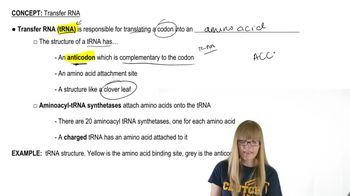
Understand the role of tRNA synthetases: tRNA synthetases are enzymes responsible for attaching specific amino acids to their corresponding tRNAs. This process is crucial for translation, as the charged tRNA delivers the correct amino acid to the ribosome during protein synthesis.
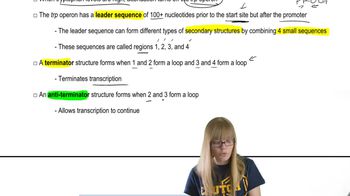
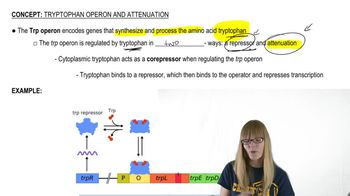
Review the concept of attenuation in the tryptophan operon: Attenuation is a regulatory mechanism in bacteria where transcription of the operon is terminated prematurely based on the availability of tryptophan. When tryptophan levels are high, the ribosome quickly translates the leader peptide, allowing the formation of a terminator structure in the mRNA that halts transcription.
Analyze the impact of reduced tRNA synthetase efficiency: If the tRNA synthetase responsible for attaching tryptophan to tRNA functions at only 15% efficiency, fewer tryptophan-charged tRNAs will be available. This would slow down translation of the leader peptide, as the ribosome would stall at tryptophan codons due to the lack of charged tRNAs.
Predict the effect on attenuation: The ribosome stalling at tryptophan codons would prevent the formation of the terminator structure in the mRNA. Instead, an anti-terminator structure would form, allowing transcription of the tryptophan operon to continue. This ensures that more tryptophan biosynthetic enzymes are produced to compensate for the reduced efficiency of the tRNA synthetase.
Summarize the overall outcome: The mutation in the tRNA synthetase would lead to reduced attenuation of the tryptophan operon, resulting in increased transcription of the operon to produce enzymes for tryptophan synthesis, helping the cell adapt to the lower availability of charged tRNAs.

Verified video answer for a similar problem:

This video solution was recommended by our tutors as helpful for the problem above.
Video duration:
4m
Was this helpful?

Key Concepts

Here are the essential concepts you must grasp in order to answer the question correctly.

tRNA Synthetases

tRNA synthetases are enzymes that catalyze the attachment of specific amino acids to their corresponding tRNA molecules, a process known as aminoacylation. This is crucial for accurate protein synthesis, as each tRNA carries a specific amino acid that corresponds to the codon in the mRNA. A mutation that reduces the efficiency of a tRNA synthetase can lead to a decrease in the availability of the amino acid for protein synthesis, potentially affecting cellular functions.
Recommended video:

Attenuation in Gene Regulation

Attenuation is a regulatory mechanism in prokaryotes that controls gene expression, particularly in operons like the tryptophan operon. It involves the formation of specific RNA structures that can either promote or inhibit transcription based on the availability of the amino acid. In the case of tryptophan, if tryptophan levels are low, the ribosome stalls, allowing the formation of a transcriptional antiterminator, leading to continued transcription of the operon.
Recommended video:
Guided course
09:11
Trp Attenuation

Impact of Amino Acid Availability

The availability of amino acids directly influences the efficiency of protein synthesis and the regulation of operons. In the scenario of a mutated tRNA synthetase for tryptophan, the reduced efficiency would lead to lower levels of tryptophan in the cell. This could result in altered attenuation of the tryptophan operon, potentially leading to increased transcription of the operon as the cell attempts to compensate for the low tryptophan levels.
Recommended video:
Guided course
02:33
Trp Repressor
Related Practice
Textbook Question

For an E. coli strain with the lac operon genotype I⁺ P⁺ O⁺ Z⁺ Y⁺, identify the level of transcription of the operon genes in each growth medium listed. Specify transcription as 'none,' 'basal,' or 'activated' for each medium, and provide an explanation to justify your answer.

Growth medium contains glucose but no lactose.

843
views
Textbook Question

For an E. coli strain with the lac operon genotype I⁺ P⁺ O⁺ Z⁺ Y⁺, identify the level of transcription of the operon genes in each growth medium listed. Specify transcription as 'none,' 'basal,' or 'activated' for each medium, and provide an explanation to justify your answer.

Growth medium contains lactose but no glucose.

839
views
Textbook Question

How could antisense RNA be used as an antibiotic? What types of genes would you target using this scheme?

529
views
Textbook Question

The function of tRNA synthetases is to attach amino acids to tRNAs. Suppose the tRNA synthetase responsible for attaching tryptophan to tRNA is mutated in a bacterial strain, with the result that the tRNA synthetase functions at about 15% of the efficiency of the wild-type tRNA synthetase. Would formation of the 3–4 stem-loop structure in mRNA be more frequent or less frequent in the mutant strain than in the wild-type strain? Why?

487
views
Textbook Question

The following hypothetical genotypes have genes A, B, and C corresponding to lacI, lacO, and lacZ, but not necessarily in that order. Data in the table indicate whether β-galactosidase is produced in the presence and absence of the inducer for each genotype. Use these data to identify the correspondence between A, B, and C and the lacI, lacO, and lacZ genes. Carefully explain your reasoning for identifying each gene.

518
views
Textbook Question

Northern blot analysis is performed on cellular mRNA isolated from E. coli. The probe used in the northern blot analysis hybridizes to a portion of the lacY sequence. Below is an example of the gel from northern blot analysis for a wild-type lac⁺ bacterial strain. In this gel, lane 1 is from bacteria grown in a medium containing only glucose (minimal medium). Lane 2 is from bacteria in a medium containing only lactose. Following the style of this diagram, draw the gel appearance for northern blots of the bacteria listed below. In each case, lane 1 is for mRNA isolated after growth in a glucose-containing (minimal) medium, and lane 2 is for mRNA isolated after growth in a lactose-only medium.

lac⁺ bacteria with the genotype I⁺ P⁺ OC Z⁺ Y⁺ 

802
views