Pearson+ LogoPearson+ Logo
Ch. 12 - Regulation of Gene Expression in Bacteria and Bacteriophage
Sanders - Genetic Analysis: An Integrated Approach 3rd Edition
Sanders3rd EditionGenetic Analysis: An Integrated ApproachISBN: 9780135564172Not the one you use?Change textbook
Chapter 12, Problem 34a

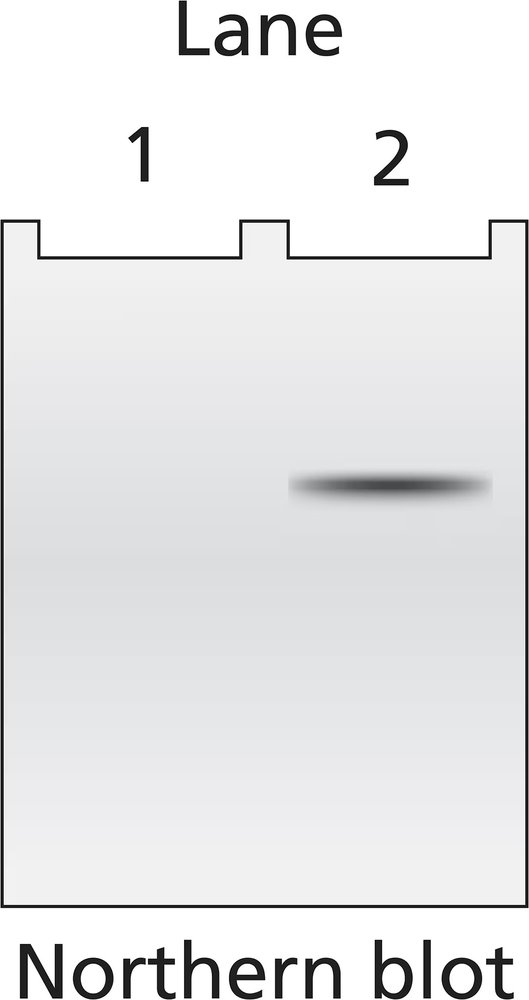
Northern blot analysis is performed on cellular mRNA isolated from E. coli. The probe used in the northern blot analysis hybridizes to a portion of the lacY sequence. Below is an example of the gel from northern blot analysis for a wild-type lac⁺ bacterial strain. In this gel, lane 1 is from bacteria grown in a medium containing only glucose (minimal medium). Lane 2 is from bacteria in a medium containing only lactose. Following the style of this diagram, draw the gel appearance for northern blots of the bacteria listed below. In each case, lane 1 is for mRNA isolated after growth in a glucose-containing (minimal) medium, and lane 2 is for mRNA isolated after growth in a lactose-only medium.
Northern blot showing mRNA bands for lanes 1 and 2 from E. coli grown in glucose and lactose media, respectively.
lac⁺ bacteria with the genotype I⁺ P⁺ OC Z⁺ Y⁺ 

Verified step by step guidance
1
Understand the context of the problem: Northern blot analysis is used to detect specific RNA sequences in a sample. In this case, the probe hybridizes to the lacY mRNA, which is part of the lac operon in E. coli. The lac operon is regulated by the presence of glucose and lactose in the medium.
Review the genotype provided: The genotype I⁺ P⁺ Oᶜ Z⁺ Y⁺ indicates that the lac operon has a constitutive operator (Oᶜ), meaning the operon is always active regardless of the presence of glucose or lactose. The other components (I⁺, P⁺, Z⁺, Y⁺) are functional, ensuring proper transcription and translation of the lac operon genes.
Analyze the expected mRNA expression: Since the operator is constitutive (Oᶜ), the lac operon will produce mRNA continuously, regardless of the medium (glucose or lactose). This means that lacY mRNA will be present in both lane 1 (glucose medium) and lane 2 (lactose medium).
Determine the gel appearance: In the northern blot gel, both lanes (lane 1 and lane 2) will show a band corresponding to the lacY mRNA. The intensity of the bands should be similar in both lanes because the constitutive operator ensures constant expression.
Summarize the reasoning: The presence of the Oᶜ mutation overrides normal regulation by glucose or lactose, leading to continuous transcription of the lac operon genes, including lacY. This explains why the northern blot gel will show bands in both lanes with similar intensity.

Verified video answer for a similar problem:

This video solution was recommended by our tutors as helpful for the problem above.
Video duration:
3m
Was this helpful?

Key Concepts

Here are the essential concepts you must grasp in order to answer the question correctly.

Northern Blotting

Northern blotting is a technique used to detect specific RNA sequences in a sample. It involves the separation of RNA by gel electrophoresis, transfer to a membrane, and hybridization with a labeled probe that binds to the target RNA. This method allows researchers to analyze gene expression by comparing the levels of mRNA in different conditions or treatments.
Recommended video:
Guided course
07:40
Methods for Analyzing DNA and RNA

Lac Operon

The lac operon is a set of genes in E. coli that are involved in the metabolism of lactose. It consists of structural genes (lacZ, lacY, and lacA) and regulatory elements that control their expression. The operon is typically activated in the presence of lactose and repressed when glucose is available, illustrating the concept of catabolite repression in bacterial gene regulation.
Recommended video:
Guided course
04:27
Lac Operon Overview

Gene Expression Regulation

Gene expression regulation refers to the mechanisms that control the timing and amount of gene product (RNA or protein) produced in a cell. In the context of the lac operon, the presence of glucose inhibits the expression of genes necessary for lactose metabolism, while lactose induces their expression. Understanding these regulatory mechanisms is crucial for interpreting results from experiments like Northern blotting.
Recommended video:
Guided course
02:09
Penetrance and Expressivity
Related Practice
Textbook Question

The function of tRNA synthetases is to attach amino acids to tRNAs. Suppose the tRNA synthetase responsible for attaching tryptophan to tRNA is mutated in a bacterial strain, with the result that the tRNA synthetase functions at about 15% of the efficiency of the wild-type tRNA synthetase.

How would this mutation affect attenuation of the tryptophan operon? Explain your answer.

467
views
Textbook Question

The function of tRNA synthetases is to attach amino acids to tRNAs. Suppose the tRNA synthetase responsible for attaching tryptophan to tRNA is mutated in a bacterial strain, with the result that the tRNA synthetase functions at about 15% of the efficiency of the wild-type tRNA synthetase. Would formation of the 3–4 stem-loop structure in mRNA be more frequent or less frequent in the mutant strain than in the wild-type strain? Why?

487
views
Textbook Question

The following hypothetical genotypes have genes A, B, and C corresponding to lacI, lacO, and lacZ, but not necessarily in that order. Data in the table indicate whether β-galactosidase is produced in the presence and absence of the inducer for each genotype. Use these data to identify the correspondence between A, B, and C and the lacI, lacO, and lacZ genes. Carefully explain your reasoning for identifying each gene.

518
views
Textbook Question

Northern blot analysis is performed on cellular mRNA isolated from E. coli. The probe used in the northern blot analysis hybridizes to a portion of the lacY sequence. Below is an example of the gel from northern blot analysis for a wild-type lac⁺ bacterial strain. In this gel, lane 1 is from bacteria grown in a medium containing only glucose (minimal medium). Lane 2 is from bacteria in a medium containing only lactose. Following the style of this diagram, draw the gel appearance for northern blots of the bacteria listed below. In each case, lane 1 is for mRNA isolated after growth in a glucose-containing (minimal) medium, and lane 2 is for mRNA isolated after growth in a lactose-only medium.

lac⁻ bacteria with the genotype I⁺ P⁺ O⁺ Z⁻ Y⁺ 

568
views
Textbook Question

Northern blot analysis is performed on cellular mRNA isolated from E. coli. The probe used in the northern blot analysis hybridizes to a portion of the lacY sequence. Below is an example of the gel from northern blot analysis for a wild-type lac⁺ bacterial strain. In this gel, lane 1 is from bacteria grown in a medium containing only glucose (minimal medium). Lane 2 is from bacteria in a medium containing only lactose. Following the style of this diagram, draw the gel appearance for northern blots of the bacteria listed below. In each case, lane 1 is for mRNA isolated after growth in a glucose-containing (minimal) medium, and lane 2 is for mRNA isolated after growth in a lactose-only medium.

lac⁻ bacteria with the genotype I⁺ P⁻ OC Z⁺ Y⁺

521
views
Textbook Question

Northern blot analysis is performed on cellular mRNA isolated from E. coli. The probe used in the northern blot analysis hybridizes to a portion of the lacY sequence. Below is an example of the gel from northern blot analysis for a wild-type lac⁺ bacterial strain. In this gel, lane 1 is from bacteria grown in a medium containing only glucose (minimal medium). Lane 2 is from bacteria in a medium containing only lactose. Following the style of this diagram, draw the gel appearance for northern blots of the bacteria listed below. In each case, lane 1 is for mRNA isolated after growth in a glucose-containing (minimal) medium, and lane 2 is for mRNA isolated after growth in a lactose-only medium.

lac⁺ bacteria with the genotype I⁻ P⁺ OC Z⁺ Y⁺ 

685
views