Pearson+ LogoPearson+ Logo
Ch. 15 - Recombinant DNA Technology and Its Applications
Sanders - Genetic Analysis: An Integrated Approach 3rd Edition
Sanders3rd EditionGenetic Analysis: An Integrated ApproachISBN: 9780135564172Not the one you use?Change textbook
Chapter 15, Problem 4b

You have constructed four different libraries: a genomic library made from DNA isolated from human brain tissue, a genomic library made from DNA isolated from human muscle tissue, a human brain cDNA library, and a human muscle cDNA library.
Would the sequences contained in each library be expected to overlap completely, partially, or not at all with the sequences present in each of the other libraries?

Verified step by step guidance
1
Understand the difference between genomic libraries and cDNA libraries: Genomic libraries contain DNA sequences representing the entire genome of an organism, including both coding (exons) and non-coding regions (introns, regulatory sequences, etc.). cDNA libraries, on the other hand, are constructed from mRNA and represent only the expressed genes (coding regions) in a specific tissue at a specific time.
Consider the genomic libraries: Since both the human brain genomic library and the human muscle genomic library are derived from the entire genome, they will contain identical sequences. The genome is the same across all tissues, so these libraries will overlap completely.
Analyze the cDNA libraries: The human brain cDNA library and the human muscle cDNA library are derived from mRNA, which reflects the genes actively expressed in each tissue. Different tissues express different sets of genes, so these libraries will overlap partially, as some genes are expressed in both tissues while others are tissue-specific.
Compare genomic libraries to cDNA libraries: Genomic libraries contain all DNA sequences, while cDNA libraries contain only expressed genes. Therefore, the sequences in genomic libraries will overlap partially with those in cDNA libraries, as cDNA libraries represent a subset of the genome (the expressed genes).
Summarize the relationships: The human brain genomic library and human muscle genomic library overlap completely. The human brain cDNA library and human muscle cDNA library overlap partially. Genomic libraries overlap partially with cDNA libraries because cDNA libraries represent only the expressed genes in specific tissues.

Verified video answer for a similar problem:

This video solution was recommended by our tutors as helpful for the problem above.
Video duration:
5m
Was this helpful?

Key Concepts

Here are the essential concepts you must grasp in order to answer the question correctly.

Genomic Library

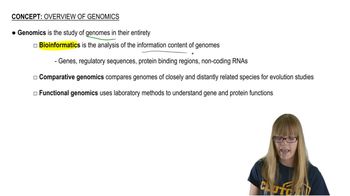
A genomic library is a collection of DNA fragments that represent the entire genome of an organism. It includes both coding (exons) and non-coding (introns) regions of DNA. Libraries constructed from different tissues may contain overlapping sequences, but the extent of overlap depends on the tissue-specific expression of genes and the presence of non-coding regions.
Recommended video:
Guided course
02:48
Genomics Overview

cDNA Library

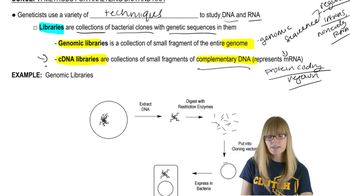
A cDNA library is created from complementary DNA synthesized from mRNA transcripts, representing only the expressed genes in a specific tissue at a given time. Since cDNA libraries are tissue-specific, the sequences in a brain cDNA library will differ from those in a muscle cDNA library, reflecting the unique gene expression profiles of each tissue.
Recommended video:
Guided course
07:40
Methods for Analyzing DNA and RNA

Gene Expression

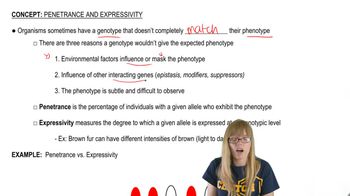
Gene expression refers to the process by which information from a gene is used to synthesize functional gene products, typically proteins. Different tissues express different sets of genes based on their specific functions, leading to variations in the sequences found in genomic and cDNA libraries. This results in partial overlap between libraries derived from different tissues.
Recommended video:
Guided course
02:09
Penetrance and Expressivity
Related Practice
Textbook Question

The human genome is 3×10⁹ bp in length.

How would your initial answer change if you knew that the average GC content of the human genome was 40%?

702
views
Textbook Question

Ligase catalyzes a reaction between the 5′ phosphate and the 3′ hydroxyl groups at the ends of DNA molecules. The enzyme calf intestinal phosphatase catalyzes the removal of the 5′5′ phosphate from DNA molecules. What would be the consequence of treating a cloning vector, before ligation, with calf intestinal phosphatase?

432
views
Textbook Question

You have constructed four different libraries: a genomic library made from DNA isolated from human brain tissue, a genomic library made from DNA isolated from human muscle tissue, a human brain cDNA library, and a human muscle cDNA library.

Which of these would have the greatest diversity of sequences?

832
views
Textbook Question

Using the genomic libraries, you wish to clone the human gene encoding myostatin, which is expressed only in muscle cells.

Assuming the human genome is 3x10⁹ bp and that the average insert size in the genomic libraries is 100 kb, how frequently will a clone representing myostatin be found in the genomic library made from muscle?

561
views
Textbook Question

Using the genomic libraries, you wish to clone the human gene encoding myostatin, which is expressed only in muscle cells.

How frequently will a clone representing myostatin be found in the genomic library made from brain?

504
views
Textbook Question

Using the genomic libraries, you wish to clone the human gene encoding myostatin, which is expressed only in muscle cells.

How frequently will a clone representing myostatin be found in the cDNA library made from muscle?

515
views