Pearson+ LogoPearson+ Logo
Ch. 19 - Genetic Analysis of Quantitative Traits
Sanders - Genetic Analysis: An Integrated Approach 3rd Edition
Sanders3rd EditionGenetic Analysis: An Integrated ApproachISBN: 9780135564172Not the one you use?Change textbook
Chapter 19, Problem 7a

Provide a definition and an example for each of the following terms:
Additive genes

Verified step by step guidance
1
Define additive genes: Additive genes refer to a situation in genetics where multiple genes contribute to a single trait, and the effects of these genes are cumulative. Each gene adds a small, measurable amount to the phenotype, and their combined effects determine the overall expression of the trait.
Explain the concept: In additive gene interactions, there is no dominance or epistasis involved. Instead, the phenotype is the result of the sum of the contributions from all the involved alleles.
Provide an example: A classic example of additive genes is human skin color. Multiple genes contribute to the production of melanin, and the cumulative effect of these genes determines the shade of skin color.
Illustrate the genetic mechanism: For instance, if two genes (A and B) each have two alleles (A1, A2 and B1, B2), the alleles A1 and B1 might contribute more to melanin production than A2 and B2. The total melanin production is the sum of the contributions from all alleles present in an individual.
Conclude with significance: Additive genes are important in understanding quantitative traits, such as height, weight, and crop yield, which are influenced by the combined effects of multiple genes and environmental factors.

Verified video answer for a similar problem:

This video solution was recommended by our tutors as helpful for the problem above.
Video duration:
1m
Was this helpful?

Key Concepts

Here are the essential concepts you must grasp in order to answer the question correctly.

Additive Genes

Additive genes are those that contribute to a trait in a cumulative manner, meaning that the effects of these genes add together to influence the phenotype. For example, in the case of skin color in humans, multiple additive genes may work together, with each gene contributing a small amount to the overall pigmentation, resulting in a continuous range of skin tones.
Recommended video:
Guided course
09:09
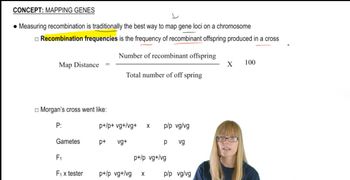
Mapping Genes

Polygenic Inheritance

Polygenic inheritance refers to the phenomenon where multiple genes (often located on different chromosomes) collectively influence a single trait. This type of inheritance leads to a wide variety of phenotypes, as seen in traits like height or weight, where the interaction of several additive genes results in a continuous distribution of characteristics rather than discrete categories.
Recommended video:
Guided course
05:13
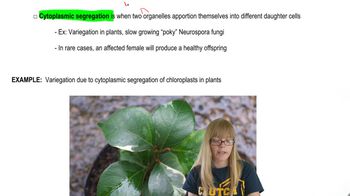
Organelle Inheritance

Phenotype

Phenotype is the observable physical or biochemical characteristics of an organism, determined by both genetic makeup and environmental influences. In the context of additive genes, the phenotype reflects the cumulative effects of these genes, illustrating how variations in genetic contributions can lead to diverse traits within a population.
Recommended video:
Guided course
10:48
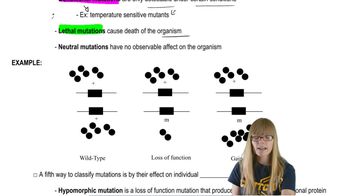
Mutations and Phenotypes