Look over the 10 diseases approved for genetic health risk assessment listed in Application Chapter B. Select one disease other than the three discussed in Application Chapter B or in this chapter (alpha-1 antitrypsin deficiency, late-onset Alzheimer disease, and celiac disease) or another of the diseases of your choice. Do a brief Internet search to find and download (1) one article for a nonscientific audience identifying the gene or genes whose alleles are associated with occurrence of the disease and (2) one scientific paper that provides data supporting the association of specific alleles of the gene or genes with the disease. Write a short summary combining the information contained in the two papers.
Ch. 20 - Population Genetics and Evolution at the Population, Species, and Molecular Levels

Sanders3rd EditionGenetic Analysis: An Integrated ApproachISBN: 9780135564172Not the one you use?Change textbook
All textbooks
Sanders 3rd Edition
Ch. 20 - Population Genetics and Evolution at the Population, Species, and Molecular Levels
Problem D.1
Sanders 3rd Edition
Ch. 20 - Population Genetics and Evolution at the Population, Species, and Molecular Levels
Problem D.1Chapter 20, Problem D.1
Why might mitochondrial, Y chromosome, and autosomal DNA provide different perspectives on our evolutionary past, for example, with respect to our relationship with Neanderthals?
Verified step by step guidance1
Understand that mitochondrial DNA (mtDNA), Y chromosome DNA, and autosomal DNA are inherited differently: mtDNA is maternally inherited, Y chromosome DNA is paternally inherited, and autosomal DNA is inherited from both parents.
Recognize that because mtDNA and Y chromosome DNA do not undergo recombination (or very little), they trace direct maternal and paternal lineages respectively, providing a more linear and specific ancestral path.
Note that autosomal DNA recombines every generation, mixing genetic material from all ancestors, which offers a broader and more complex picture of ancestry and gene flow, including interbreeding events.
Consider that differences in inheritance patterns mean mtDNA and Y chromosome analyses might miss some gene flow events that autosomal DNA can detect, such as interbreeding between modern humans and Neandertals.
Conclude that these different types of DNA provide complementary perspectives: mtDNA and Y chromosome DNA highlight direct maternal and paternal lineages, while autosomal DNA reveals the overall genetic contributions from multiple ancestors, including admixture with Neandertals.

Verified video answer for a similar problem:
This video solution was recommended by our tutors as helpful for the problem above.
Video duration:
2mWas this helpful?
Key Concepts
Here are the essential concepts you must grasp in order to answer the question correctly.
Mitochondrial DNA Inheritance
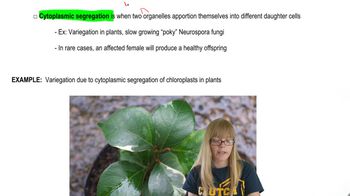
Mitochondrial DNA (mtDNA) is inherited exclusively from the mother and does not recombine, providing a direct maternal lineage. This makes mtDNA useful for tracing maternal ancestry and evolutionary history, but it represents only a small fraction of the genome and one lineage path.
Recommended video:
Guided course
Organelle Inheritance
Y Chromosome Inheritance
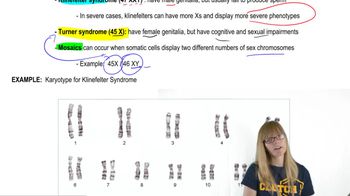
The Y chromosome is passed from father to son and also does not undergo recombination over most of its length. It traces paternal lineage, offering insights into male-specific ancestry and population history, which can differ from maternal or autosomal perspectives.
Recommended video:
Guided course
Human Sex Chromosomes
Autosomal DNA and Recombination
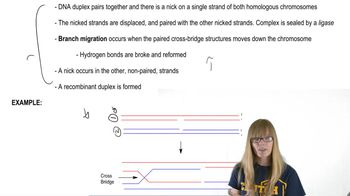
Autosomal DNA is inherited from both parents and undergoes recombination each generation, mixing genetic material from many ancestors. This provides a more comprehensive and complex picture of ancestry and evolutionary relationships, including admixture events like interbreeding with Neandertals.
Recommended video:
Guided course
Recombination after Single Strand Breaks
Related Practice
Textbook Question
508
views
Textbook Question
What insights have analyses of human mitochondrial DNA provided into our recent evolutionary past?
872
views
Textbook Question
What lines of evidence support the hypothesis that modern humans evolved in Africa and then subsequently migrated throughout the globe?
573
views
Textbook Question
Discuss how both gains and losses of regulatory elements may lead to human-specific traits.
483
views