Pearson+ LogoPearson+ Logo
Ch. 4 - Gene Interaction
Sanders - Genetic Analysis: An Integrated Approach 3rd Edition
Sanders3rd EditionGenetic Analysis: An Integrated ApproachISBN: 9780135564172Not the one you use?Change textbook
Chapter 4, Problem 8d

Two genes interact to produce various phenotypic ratios among F₂ progeny of a dihybrid cross. Design a different pathway explaining each of the F₂ ratios below, using hypothetical genes R and T and assuming that the dominant allele at each locus catalyzes a different reaction or performs an action leading to pigment production. The recessive allele at each locus is null (loss-of-function). Begin each pathway with a colorless precursor that produces a white or albino phenotype if it is unmodified. The ratios are for F₂ progeny produced by crossing wild-type F₁ organisms with the genotype RrTt.
9/16 red : 7/16 white

Verified step by step guidance
1
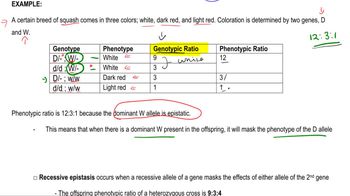
Define the genetic basis of the problem: The F₂ phenotypic ratio of 9/16 red : 7/16 white suggests a complementary gene interaction. This means that both genes (R and T) are required to produce the red pigment, and the absence of a dominant allele at either locus results in a white phenotype.
Establish the biochemical pathway: Assume a colorless precursor (P) is converted to an intermediate (I) by the action of the dominant allele R. Then, the intermediate (I) is converted to the final red pigment by the action of the dominant allele T. If either R or T is missing (homozygous recessive), the pathway is blocked, resulting in a white phenotype.
Write the genotypic contributions: The genotypes R_T_ (where _ represents any allele) will produce the red pigment because both dominant alleles are present and the pathway is complete. The genotypes rrT_, R_tt, and rrtt will result in a white phenotype because at least one step in the pathway is blocked.
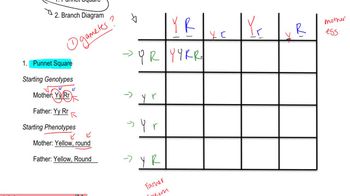
Explain the phenotypic ratio: In a dihybrid cross (RrTt × RrTt), the expected genotypic ratio is 9:3:3:1. However, due to the complementary gene interaction, the 9/16 R_T_ individuals produce red pigment, while the remaining 7/16 (3/16 rrT_ + 3/16 R_tt + 1/16 rrtt) produce a white phenotype.
Summarize the pathway: The pathway can be summarized as follows: Colorless precursor (P) → [R allele] → Intermediate (I) → [T allele] → Red pigment. If either R or T is missing, the pathway stops, and the phenotype is white.

Verified video answer for a similar problem:

This video solution was recommended by our tutors as helpful for the problem above.
Video duration:
2m
Was this helpful?

Key Concepts

Here are the essential concepts you must grasp in order to answer the question correctly.

Dihybrid Cross

A dihybrid cross involves two traits, each represented by two alleles, allowing the study of inheritance patterns for two genes simultaneously. In this case, the genes R and T are being analyzed for their interactions in producing phenotypes. The classic Mendelian ratio of 9:3:3:1 is often expected, but different interactions can lead to modified ratios, such as the 9/16 red to 7/16 white ratio mentioned.
Recommended video:
Guided course
15:24
Punnet Square

Epistasis

Epistasis occurs when the expression of one gene is affected by another gene, leading to altered phenotypic ratios. In the context of the question, the dominant alleles of genes R and T may interact in such a way that they influence pigment production differently, resulting in the observed ratios. Understanding how these genes interact is crucial for explaining the phenotypic outcomes in the F₂ progeny.
Recommended video:
Guided course
13:08
Epistatic Genes

Loss-of-Function Alleles

Loss-of-function alleles are mutations that result in the complete or partial inactivation of a gene, leading to a lack of functional protein. In this scenario, the recessive alleles at both loci (r and t) are null alleles, meaning they do not contribute to pigment production. This concept is essential for understanding how the presence of dominant alleles can lead to different phenotypic expressions in the progeny.
Recommended video:
Guided course
08:26
Functional Genomics
Related Practice
Textbook Question

Two genes interact to produce various phenotypic ratios among F₂ progeny of a dihybrid cross. Design a different pathway explaining each of the F₂ ratios below, using hypothetical genes R and T and assuming that the dominant allele at each locus catalyzes a different reaction or performs an action leading to pigment production. The recessive allele at each locus is null (loss-of-function). Begin each pathway with a colorless precursor that produces a white or albino phenotype if it is unmodified. The ratios are for F₂ progeny produced by crossing wild-type F₁ organisms with the genotype RrTt.

9/16 dark blue : 6/16 light blue : 1/16 white

349
views
Textbook Question

Two genes interact to produce various phenotypic ratios among F₂ progeny of a dihybrid cross. Design a different pathway explaining each of the F₂ ratios below, using hypothetical genes R and T and assuming that the dominant allele at each locus catalyzes a different reaction or performs an action leading to pigment production. The recessive allele at each locus is null (loss-of-function). Begin each pathway with a colorless precursor that produces a white or albino phenotype if it is unmodified. The ratios are for F₂ progeny produced by crossing wild-type F₁ organisms with the genotype RrTt.

12/16 white : 3/16 green : 1/16 yellow

381
views
Textbook Question

Two genes interact to produce various phenotypic ratios among F₂ progeny of a dihybrid cross. Design a different pathway explaining each of the F₂ ratios below, using hypothetical genes R and T and assuming that the dominant allele at each locus catalyzes a different reaction or performs an action leading to pigment production. The recessive allele at each locus is null (loss-of-function). Begin each pathway with a colorless precursor that produces a white or albino phenotype if it is unmodified. The ratios are for F₂ progeny produced by crossing wild-type F₁ organisms with the genotype RrTt.

9/16 green : 3/16 yellow : 3/16 blue : 1/16 white

383
views
Textbook Question

Two genes interact to produce various phenotypic ratios among F₂ progeny of a dihybrid cross. Design a different pathway explaining each of the F₂ ratios below, using hypothetical genes R and T and assuming that the dominant allele at each locus catalyzes a different reaction or performs an action leading to pigment production. The recessive allele at each locus is null (loss-of-function). Begin each pathway with a colorless precursor that produces a white or albino phenotype if it is unmodified. The ratios are for F₂ progeny produced by crossing wild-type F₁ organisms with the genotype RrTt.

15/16 black : 1/16 white

377
views
Textbook Question

Two genes interact to produce various phenotypic ratios among F₂ progeny of a dihybrid cross. Design a different pathway explaining each of the F₂ ratios below, using hypothetical genes R and T and assuming that the dominant allele at each locus catalyzes a different reaction or performs an action leading to pigment production. The recessive allele at each locus is null (loss-of-function). Begin each pathway with a colorless precursor that produces a white or albino phenotype if it is unmodified. The ratios are for F₂ progeny produced by crossing wild-type F₁ organisms with the genotype RrTt.

9/16 black : 3/16 gray : 4/16 albino

408
views
Textbook Question

Two genes interact to produce various phenotypic ratios among F₂ progeny of a dihybrid cross. Design a different pathway explaining each of the F₂ ratios below, using hypothetical genes R and T and assuming that the dominant allele at each locus catalyzes a different reaction or performs an action leading to pigment production. The recessive allele at each locus is null (loss-of-function). Begin each pathway with a colorless precursor that produces a white or albino phenotype if it is unmodified. The ratios are for F₂ progeny produced by crossing wild-type F₁ organisms with the genotype RrTt.

13/16 white : 3/16 green

401
views