Pearson+ LogoPearson+ Logo
Ch.13 Alkenes, Alkynes, and Aromatic Compounds
McMurry - Fundamentals of GOB 8th Edition
McMurry8th EditionFundamentals of GOBISBN: 9780134015187Not the one you use?Change textbook
Chapter 13, Problem 11

Draw all possible products formed when 2-methyl-2-butene undergoes addition with HCl. Label them as being either the major or the minor product.

Verified step by step guidance
1
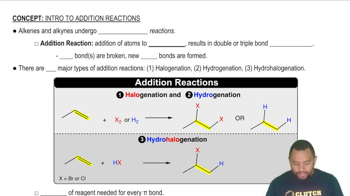
Step 1: Recognize that the reaction involves the addition of HCl to 2-methyl-2-butene, which is an alkene. This is an electrophilic addition reaction where the double bond in the alkene reacts with HCl to form an alkyl halide.
Step 2: Identify the structure of 2-methyl-2-butene. It is a branched alkene with the molecular formula C5H10. The double bond is between the second and third carbon atoms, and there is a methyl group attached to the second carbon.
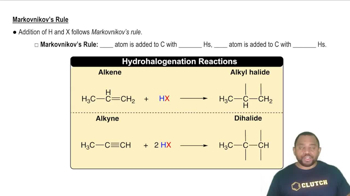
Step 3: Apply Markovnikov's rule to predict the major product. Markovnikov's rule states that the hydrogen atom from HCl will add to the carbon in the double bond that has more hydrogen atoms, while the chlorine atom will add to the carbon with fewer hydrogen atoms. This leads to the formation of the major product.
Step 4: Consider the possibility of a minor product. In some cases, a small amount of the anti-Markovnikov product may form, where the hydrogen adds to the carbon with fewer hydrogen atoms, and the chlorine adds to the carbon with more hydrogen atoms. This is less favorable but still possible.
Step 5: Draw the structures of the major and minor products. Label the product formed via Markovnikov's rule as the major product and the product formed via anti-Markovnikov addition as the minor product. Ensure the correct placement of the chlorine atom and the hydrogen atom in each product.

Verified video answer for a similar problem:

This video solution was recommended by our tutors as helpful for the problem above.
Was this helpful?

Key Concepts

Here are the essential concepts you must grasp in order to answer the question correctly.

Electrophilic Addition

Electrophilic addition is a fundamental reaction mechanism in organic chemistry where an electrophile reacts with a nucleophile, typically involving alkenes. In the case of 2-methyl-2-butene and HCl, the double bond of the alkene acts as a nucleophile, attacking the electrophilic hydrogen in HCl, leading to the formation of carbocation intermediates.
Recommended video:
Guided course
2:55
Addition Reactions Concept 1

Carbocation Stability

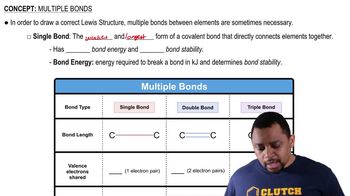
Carbocation stability is crucial in determining the major and minor products of electrophilic addition reactions. More stable carbocations, such as tertiary or secondary, are favored over less stable primary carbocations. In the reaction of 2-methyl-2-butene with HCl, the formation of a more stable tertiary carbocation will lead to the major product, while the less stable carbocation will yield the minor product.
Recommended video:
Guided course
02:26
Multiple Bonds Concept 1

Markovnikov's Rule

Markovnikov's Rule states that in the addition of HX to an alkene, the hydrogen atom from HX will attach to the carbon with the greater number of hydrogen atoms already attached. This rule helps predict the regioselectivity of the reaction products. In the case of 2-methyl-2-butene and HCl, applying Markovnikov's Rule will guide the identification of the major product formed from the more stable carbocation.
Recommended video:
Guided course
1:37
Markovnikov's Rule Concept 2