Pearson+ LogoPearson+ Logo
Ch.10 Proteins Workers of the Cell
Frost - General, Organic and Biological Chemistry 4th Edition
Frost4th EditionGeneral, Organic and Biological ChemistryISBN: 9780134988696Not the one you use?Change textbook
Chapter 6, Problem 12a

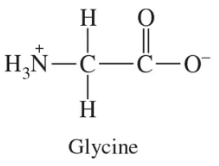
Glycine has the zwitterion structure shown. Draw the structure and give the net charge of glycine that will predominate at the indicated pH values (pI = 6.0).
a. pH 1.5

Verified step by step guidance
1
Understand the concept of a zwitterion: A zwitterion is a molecule that contains both positive and negative charges but is overall electrically neutral. Glycine, an amino acid, exists as a zwitterion at its isoelectric point (pI), which is pH 6.0.
Identify the functional groups in glycine: Glycine has an amino group (-NH2) and a carboxylic acid group (-COOH). At different pH levels, these groups can gain or lose protons (H⁺), affecting the molecule's net charge.
Analyze the pH relative to the pI: At pH 1.5, the environment is highly acidic (lower than the pI of 6.0). In acidic conditions, the carboxylic acid group (-COOH) remains protonated, and the amino group (-NH2) becomes protonated to form -NH3⁺.
Determine the net charge at pH 1.5: With the carboxylic acid group remaining neutral (-COOH) and the amino group carrying a positive charge (-NH3⁺), the net charge of glycine at pH 1.5 will be +1.
Draw the structure of glycine at pH 1.5: Represent the molecule with the amino group as -NH3⁺ and the carboxylic acid group as -COOH. Ensure the structure reflects the protonation state at this acidic pH.

Verified video answer for a similar problem:

This video solution was recommended by our tutors as helpful for the problem above.
Video duration:
4m
Was this helpful?

Key Concepts

Here are the essential concepts you must grasp in order to answer the question correctly.

Zwitterion Structure

A zwitterion is a molecule that contains both positive and negative charges but is overall neutral. In the case of amino acids like glycine, the amino group (-NH3+) is positively charged, while the carboxyl group (-COO-) is negatively charged. This dual charge allows zwitterions to exist in various pH environments, influencing their behavior in solution.
Recommended video:
Guided course
1:01
Structural Formula Concept 2

Isoelectric Point (pI)

The isoelectric point (pI) is the pH at which a molecule, such as an amino acid, carries no net electrical charge. For glycine, the pI is 6.0, meaning that at this pH, the positive and negative charges balance out. Understanding the pI is crucial for predicting the charge of glycine at different pH levels, which affects its solubility and interactions in biological systems.
Recommended video:
Guided course
03:05
Boiling Point Elevation Concept 1

pH and Charge Relationship

The pH of a solution affects the ionization state of amino acids. At low pH (acidic conditions), amino acids tend to be protonated, leading to a net positive charge. Conversely, at high pH (basic conditions), they can lose protons, resulting in a net negative charge. Knowing how glycine's charge changes with pH is essential for determining its predominant form at specific pH values, such as 1.5.
Recommended video:
Guided course
04:56
Logarithmic Relationships