Pearson+ LogoPearson+ Logo
Ch.10 Proteins Workers of the Cell
Frost - General, Organic and Biological Chemistry 4th Edition
Frost4th EditionGeneral, Organic and Biological ChemistryISBN: 9780134988696Not the one you use?Change textbook
Chapter 6, Problem 13a

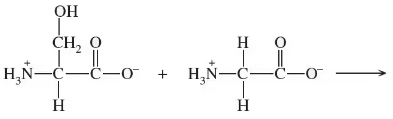
Write the products for the following condensation or hydrolysis reactions:
a.

Verified step by step guidance
1
Step 1: Identify the type of reaction (condensation or hydrolysis) based on the problem statement. Condensation reactions typically involve the combination of two molecules with the loss of a small molecule like water, while hydrolysis reactions involve the breaking of a bond in a molecule using water.
Step 2: Analyze the reactants provided in the image. Look for functional groups such as esters, amides, or other groups that are commonly involved in condensation or hydrolysis reactions.
Step 3: For a condensation reaction, determine which functional groups will combine and identify the small molecule (e.g., H₂O) that will be lost during the reaction. Write the chemical equation showing the formation of the product(s). Use MathML to represent the chemical structures and equations accurately.
Step 4: For a hydrolysis reaction, identify the bond that will be broken (e.g., ester or amide bond) and determine the products formed when water is added. Write the chemical equation showing the reactants and products, using MathML for clarity.
Step 5: Double-check the chemical structures and ensure that the products are balanced in terms of atoms and charges. Verify that the reaction follows the principles of conservation of mass and charge.

Verified video answer for a similar problem:

This video solution was recommended by our tutors as helpful for the problem above.
Video duration:
5m
Was this helpful?

Key Concepts

Here are the essential concepts you must grasp in order to answer the question correctly.

Condensation Reaction

A condensation reaction is a chemical process where two molecules combine to form a larger molecule, accompanied by the loss of a small molecule, often water. This type of reaction is fundamental in organic chemistry, particularly in the formation of polymers and complex molecules like carbohydrates and proteins.
Recommended video:
Guided course
1:53
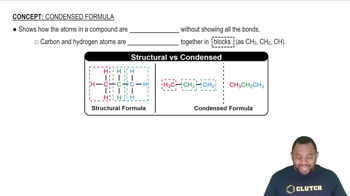
Condensed Formula Concept 1

Hydrolysis Reaction

Hydrolysis is a chemical reaction that involves the breaking down of a compound by the addition of water. In this process, a larger molecule is split into smaller units, which can be crucial for the digestion of food and the breakdown of polymers into monomers, such as in the conversion of starch into glucose.
Recommended video:
Guided course
3:09
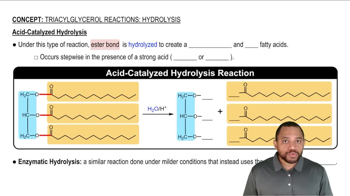
Triacylglycerol Reactions: Hydrolysis Concept 1

Reaction Products

Reaction products are the substances that result from a chemical reaction. Understanding the products of condensation and hydrolysis reactions is essential for predicting the outcomes of these processes, as they determine the structure and function of the resulting molecules in biological and chemical systems.
Recommended video:
Guided course
1:08
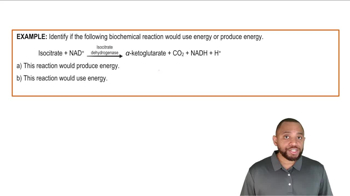
Energy Production In Biochemical Pathways Example 1