
Pearson+ LogoPearson+ Logo
Ch.7 Chemical Reactions: Energy, Rate and Equilibrium
McMurry - Fundamentals of GOB 8th Edition
McMurry8th EditionFundamentals of GOBISBN: 9780134015187Not the one you use?Change textbook
Chapter 7, Problem 56a

Use your answer from Problem 7.54 to calculate the following:
a. [O2] at equilibrium when [CO2] = 0.18 mol/L and [CO] = 0.0200 mol/L

Verified step by step guidance
1
Identify the chemical equilibrium reaction involved. For example, if the reaction is CO(g) + 1/2 O2(g) ⇌ CO2(g), write the balanced equation and note the stoichiometric relationships between the reactants and products.
Write the equilibrium constant expression (Kc) for the reaction. For the example reaction, Kc = ([CO2]) / ([CO] * [O2]^(1/2)).
Substitute the given equilibrium concentrations into the Kc expression. In this case, [CO2] = 0.18 mol/L and [CO] = 0.0200 mol/L. Let [O2] = x, which is the unknown concentration to solve for.
Rearrange the Kc expression to isolate [O2]. For the example reaction, this would involve solving for x in the equation Kc = (0.18) / (0.0200 * x^(1/2)).
Use the value of Kc from Problem 7.54 (provided in the earlier problem) to solve for x, which represents the equilibrium concentration of O2. Ensure proper algebraic manipulation and square both sides if necessary to eliminate the square root.

Verified video answer for a similar problem:

This video solution was recommended by our tutors as helpful for the problem above.
Video duration:
5m
Was this helpful?

Key Concepts

Here are the essential concepts you must grasp in order to answer the question correctly.

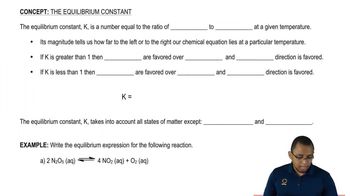
Equilibrium Constant (K)

The equilibrium constant (K) is a numerical value that expresses the ratio of the concentrations of products to reactants at equilibrium for a given chemical reaction. It is specific to a particular reaction at a certain temperature. Understanding K is essential for predicting the concentrations of reactants and products when the system reaches equilibrium.
Recommended video:
Guided course
02:50
The Equilibrium Constant Concept 1

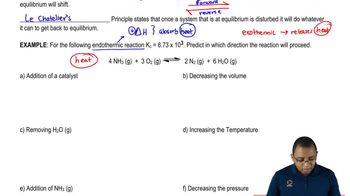
Le Chatelier's Principle

Le Chatelier's Principle states that if a dynamic equilibrium is disturbed by changing the conditions, the system will adjust itself to counteract the change and restore a new equilibrium. This principle helps in predicting how changes in concentration, pressure, or temperature will affect the position of equilibrium in a chemical reaction.

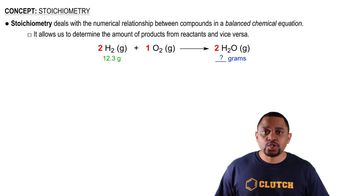
Stoichiometry

Stoichiometry involves the calculation of reactants and products in chemical reactions based on the balanced chemical equation. It allows for the determination of the relationships between the amounts of substances consumed and produced, which is crucial for calculating equilibrium concentrations when given specific initial conditions.
Recommended video:
Guided course
01:16
Stoichiometry