What is meant by the term 'chemical equilibrium'? Must amounts of reactants and products be equal at equilibrium?
Ch.7 Chemical Reactions: Energy, Rate and Equilibrium
Chapter 7, Problem 52d
Write the equilibrium constant expressions for the following reactions.
d. C(s) + H2O(g) ⇌ CO(g) + H2(g)
Verified step by step guidance1
Identify the general form of the equilibrium constant expression, which is written as K = [products] / [reactants]. Concentrations of gases are expressed in terms of partial pressures or molar concentrations, while pure solids and liquids are not included in the expression.
Recognize that in the given reaction, C(s) is a solid. Since the equilibrium constant expression does not include pure solids, C(s) will not appear in the expression.
List the gaseous species in the reaction: H2O(g), CO(g), and H2(g). These are the species that will be included in the equilibrium constant expression.
Write the equilibrium constant expression as follows: K = ([CO][H2]) / [H2O], where [CO], [H2], and [H2O] represent the molar concentrations (or partial pressures) of the respective gases at equilibrium.
Ensure that the expression is balanced and reflects the stoichiometry of the reaction. In this case, all coefficients are 1, so no exponents are needed in the equilibrium constant expression.

Verified video answer for a similar problem:
This video solution was recommended by our tutors as helpful for the problem above.
Video duration:
1mWas this helpful?
Key Concepts
Here are the essential concepts you must grasp in order to answer the question correctly.
Equilibrium Constant (K)
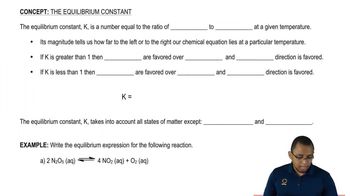
The equilibrium constant (K) is a numerical value that expresses the ratio of the concentrations of products to reactants at equilibrium for a given chemical reaction. It is specific to a particular reaction at a certain temperature and indicates the extent to which reactants are converted into products. A larger K value suggests a greater concentration of products at equilibrium, while a smaller K indicates a higher concentration of reactants.
Recommended video:
Guided course
The Equilibrium Constant Concept 1
Reaction Quotient (Q)
The reaction quotient (Q) is a measure of the relative concentrations of products and reactants at any point in time during a reaction. It is calculated using the same formula as the equilibrium constant but with the current concentrations. Comparing Q to K helps determine the direction in which a reaction will proceed to reach equilibrium: if Q < K, the reaction shifts right to produce more products; if Q > K, it shifts left to produce more reactants.
Recommended video:
Guided course
Alcohol Reactions: Dehydration Reactions Concept 1
Gaseous and Solid Reactants in K Expressions
In equilibrium constant expressions, only the concentrations of gaseous and aqueous species are included, while solids and pure liquids are omitted. This is because the activity of solids is considered constant and does not affect the equilibrium position. For the given reaction, only the gaseous products (CO and H2) and the gaseous reactant (H2O) will be included in the equilibrium expression, while the solid carbon (C) will not.
Recommended video:
Guided course
Atomic, Ionic and Molecular Solids Concept 1
Related Practice
Textbook Question
1393
views
Textbook Question
Why do catalysts not alter the amounts of reactants and products present at equilibrium?
1386
views
Textbook Question
Write the equilibrium constant expressions for the following reactions:
a. 2 CO(g) + O2(g) ⇌ 2 CO2(g)
1419
views
Textbook Question
Use your answer from Problem 7.53 to calculate the following:
a. [N2O4] at equilibrium when [NO2] = 0.0250 mol/L
1249
views
Textbook Question
Use your answer from Problem 7.54 to calculate the following:
a. [O2] at equilibrium when [CO2] = 0.18 mol/L and [CO] = 0.0200 mol/L
1197
views
Textbook Question
Oxygen can be converted into ozone by the action of lightning or electric sparks:
3 O2(g) ⇌ 2 O3(g)
For this reaction, ∆H = +69kcal/mol (+285 kj/mol) and K = 2.68 × 10⁻²⁹ at 25 °C.
a. Is the reaction exothermic or endothermic?
2515
views