Pearson+ LogoPearson+ Logo
Ch.19 Enzymes and Vitamins
McMurry - Fundamentals of GOB 8th Edition
McMurry8th EditionFundamentals of GOBISBN: 9780134015187Not the one you use?Change textbook
Chapter 19, Problem 28a

Explain how the following changes affect the rate of an enzyme-catalyzed reaction in the presence of an uncompetitive inhibitor:
(a) increasing the substrate concentration at a constant inhibitor concentration

Verified step by step guidance
1
Understand the role of an uncompetitive inhibitor: An uncompetitive inhibitor binds only to the enzyme-substrate complex, not to the free enzyme. This binding prevents the enzyme from converting the substrate into the product, effectively reducing the maximum reaction rate (Vmax) and the apparent Michaelis constant (Km).
Recognize the effect of increasing substrate concentration: In a typical enzyme-catalyzed reaction without inhibitors, increasing the substrate concentration increases the reaction rate until the enzyme becomes saturated. However, in the presence of an uncompetitive inhibitor, the inhibitor binds more effectively as the enzyme-substrate complex concentration increases.
Analyze the impact on reaction rate: As substrate concentration increases, more enzyme-substrate complexes form, which allows more uncompetitive inhibitor to bind. This further reduces the effective number of active enzyme-substrate complexes available for catalysis, limiting the reaction rate.
Relate this to Vmax and Km: The presence of the uncompetitive inhibitor decreases both Vmax and Km. Even though increasing substrate concentration would normally increase the reaction rate, the inhibitor's effect prevents the reaction from reaching the uninhibited Vmax.
Conclude the overall effect: Increasing the substrate concentration at a constant inhibitor concentration will not overcome the inhibition caused by the uncompetitive inhibitor. Instead, the reaction rate will approach a lower maximum rate (inhibited Vmax) than it would in the absence of the inhibitor.

Verified video answer for a similar problem:

This video solution was recommended by our tutors as helpful for the problem above.
Video duration:
1m
Was this helpful?

Key Concepts

Here are the essential concepts you must grasp in order to answer the question correctly.

Enzyme Kinetics

Enzyme kinetics is the study of the rates of enzyme-catalyzed reactions. It involves understanding how various factors, such as substrate concentration and inhibitors, influence the speed of these reactions. The Michaelis-Menten model is often used to describe the relationship between substrate concentration and reaction rate, providing a framework for analyzing how enzymes function under different conditions.
Recommended video:
Guided course
01:19
Kinetic Molecular Theory Concept 1

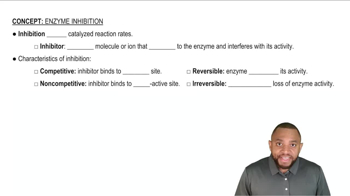
Uncompetitive Inhibition

Uncompetitive inhibition occurs when an inhibitor binds to the enzyme-substrate complex, preventing the complex from releasing products. This type of inhibition decreases both the maximum reaction rate (Vmax) and the apparent Michaelis constant (Km), effectively altering the enzyme's activity. In the presence of an uncompetitive inhibitor, increasing substrate concentration can still lead to a higher reaction rate, but the maximum rate achieved will be lower than without the inhibitor.
Recommended video:
Guided course
1:19
Enzyme Inhibition Concept 1

Substrate Concentration Effects

The concentration of substrate plays a critical role in enzyme-catalyzed reactions. As substrate concentration increases, the rate of reaction typically increases until a maximum rate is reached, where all enzyme active sites are occupied. In the context of uncompetitive inhibition, while increasing substrate concentration can enhance the reaction rate, the presence of the inhibitor means that the maximum rate will be lower than it would be without the inhibitor, illustrating the complex interplay between substrate levels and enzyme activity.
Recommended video:
Guided course
00:52
Percent Concentrations Concept 1