
Mark the chiral centers in the following molecules, if any, with an asterisk (*): (d)
Verified step by step guidance
1
Identify the definition of a chiral center: A chiral center is a carbon atom that is bonded to four different groups or atoms. This property makes the molecule non-superimposable on its mirror image.
Examine the structure of dihydroxyacetone phosphate (DHAP): This molecule contains a phosphate group, hydroxyl groups, and a carbon backbone. Carefully analyze the connectivity of each carbon atom in the molecule.
Check each carbon atom in the molecule: Determine if any carbon atom is bonded to four distinct groups. If a carbon atom meets this criterion, it is a chiral center.
Mark the chiral centers: Place an asterisk (*) next to any carbon atom that is identified as a chiral center. If no carbon atoms meet the criteria, the molecule does not have a chiral center.
Conclude the analysis: Summarize whether dihydroxyacetone phosphate contains any chiral centers and explain the reasoning based on the structure of the molecule.
Verified video answer for a similar problem:
This video solution was recommended by our tutors as helpful for the problem above
Video duration:
1m
Play a video:
Was this helpful?
Key Concepts
Here are the essential concepts you must grasp in order to answer the question correctly.
Chirality
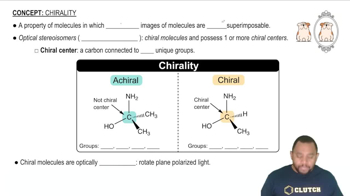
Chirality refers to the geometric property of a molecule that makes it non-superimposable on its mirror image. Molecules with chirality typically have one or more chiral centers, usually carbon atoms bonded to four different substituents. This property is crucial in biochemistry, as chiral molecules can have different biological activities depending on their orientation.
A chiral center, often a carbon atom, is a point in a molecule where the arrangement of atoms leads to chirality. For a carbon to be considered a chiral center, it must be bonded to four distinct groups. Identifying chiral centers is essential for understanding the stereochemistry of molecules, which can influence their reactivity and interaction with biological systems.
Dihydroxyacetone phosphate (DHAP) is a three-carbon sugar phosphate that plays a significant role in carbohydrate metabolism, particularly in glycolysis and gluconeogenesis. It is an important intermediate that can be converted into glyceraldehyde-3-phosphate, another key metabolite. Understanding DHAP's structure and function is vital for studying metabolic pathways and energy production in cells.