Name an enzyme that acts on each molecule. a. Amylose
Verified step by step guidance
1
Step 1: Understand the molecule in question. Amylose is a polysaccharide composed of glucose units linked by α(1→4) glycosidic bonds. It is a component of starch and serves as an energy storage molecule in plants.
Step 2: Recall the type of enzyme that breaks down polysaccharides like amylose. Enzymes that act on polysaccharides are typically classified as amylases.
Step 3: Identify the specific enzyme. The enzyme that hydrolyzes the α(1→4) glycosidic bonds in amylose is called **amylase**. Specifically, salivary amylase or pancreatic amylase can act on amylose during digestion.
Step 4: Explain the action of the enzyme. Amylase catalyzes the breakdown of amylose into smaller sugar units, such as maltose (a disaccharide) and eventually glucose, which can be absorbed by the body.
Step 5: Conclude with the enzyme's name. The enzyme that acts on amylose is **amylase**, which is essential for starch digestion in humans and other organisms.
Verified video answer for a similar problem:
This video solution was recommended by our tutors as helpful for the problem above
Video duration:
44s
Play a video:
Was this helpful?
Key Concepts
Here are the essential concepts you must grasp in order to answer the question correctly.
Enzymes
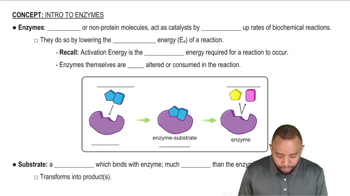
Enzymes are biological catalysts that speed up chemical reactions in living organisms. They are typically proteins that lower the activation energy required for reactions, allowing metabolic processes to occur efficiently. Each enzyme is specific to a particular substrate, meaning it only catalyzes a specific reaction or set of reactions.
Amylose is a type of polysaccharide made up of long chains of glucose units linked by α(1→4) glycosidic bonds. It is a component of starch, which serves as an energy storage molecule in plants. Understanding amylose is crucial for identifying the enzymes that can break it down into simpler sugars.
Amylase is the enzyme that specifically acts on amylose, catalyzing the hydrolysis of the glycosidic bonds in starch. There are two main types of amylase: salivary amylase, which begins starch digestion in the mouth, and pancreatic amylase, which continues the process in the small intestine. This enzyme is essential for converting starches into sugars that can be absorbed by the body.