Pearson+ LogoPearson+ Logo
Ch.19 Enzymes and Vitamins
McMurry - Fundamentals of GOB 8th Edition
McMurry8th EditionFundamentals of GOBISBN: 9780134015187Not the one you use?Change textbook
Chapter 19, Problem 35b

Which of the following is a cofactor and which is a coenzyme?
b. Pyridoxyl phosphate

Verified step by step guidance
1
Understand the difference between a cofactor and a coenzyme: A cofactor is a non-protein chemical compound or metallic ion that is required for an enzyme's activity. Cofactors can be either inorganic (e.g., metal ions like Mg²⁺ or Zn²⁺) or organic. A coenzyme, on the other hand, is a specific type of organic cofactor that is often derived from vitamins and participates in enzyme-catalyzed reactions by transferring chemical groups.
Identify the compound in question: Pyridoxal phosphate is the active form of vitamin B6 and is an organic molecule.
Determine the role of pyridoxal phosphate: It functions as a coenzyme in various enzymatic reactions, particularly in amino acid metabolism, where it helps in transamination, decarboxylation, and racemization reactions.
Classify pyridoxal phosphate: Since it is an organic molecule derived from a vitamin and participates in enzymatic reactions by transferring chemical groups, it is classified as a coenzyme.
Conclude: Pyridoxal phosphate is a coenzyme, not a cofactor in the broader sense, as it specifically fits the definition of an organic cofactor that assists enzymes in their function.

Verified video answer for a similar problem:

This video solution was recommended by our tutors as helpful for the problem above.
Video duration:
1m
Was this helpful?

Key Concepts

Here are the essential concepts you must grasp in order to answer the question correctly.

Cofactors

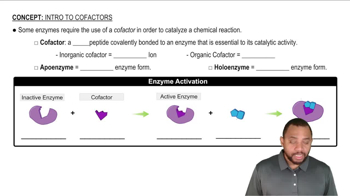
Cofactors are non-protein chemical compounds that assist enzymes in catalyzing reactions. They can be metal ions, such as zinc or magnesium, or organic molecules. Cofactors are essential for the activity of many enzymes, as they help stabilize enzyme-substrate complexes or participate directly in the chemical reaction.
Recommended video:
Guided course
2:39
Intro to Cofactors Concept 1

Coenzymes

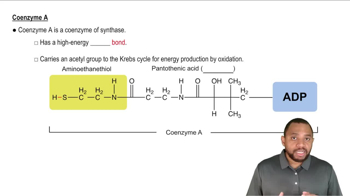
Coenzymes are a specific type of cofactor that are organic molecules, often derived from vitamins. They bind to enzymes and assist in the transfer of specific atoms or functional groups during biochemical reactions. Unlike cofactors, coenzymes are often altered during the reaction and need to be regenerated for further use.
Recommended video:
Guided course
1:02
Coenzyme A Concept 4

Pyridoxyl Phosphate

Pyridoxyl phosphate is the active form of vitamin B6 and serves as a coenzyme in various enzymatic reactions, particularly those involving amino acids. It plays a crucial role in amino acid metabolism, neurotransmitter synthesis, and the conversion of glycogen to glucose. As a coenzyme, it facilitates the transfer of amino groups and other functional groups in metabolic pathways.
Recommended video:
Guided course
01:52
Naming Ionic Compounds