Pearson+ LogoPearson+ Logo
Ch.19 Enzymes and Vitamins
McMurry - Fundamentals of GOB 8th Edition
McMurry8th EditionFundamentals of GOBISBN: 9780134015187Not the one you use?Change textbook
Chapter 19, Problem 36c

What general kinds of reactions do the following types of enzymes catalyze?
c. Lipases

Verified step by step guidance
1
Understand that enzymes are biological catalysts that speed up specific chemical reactions. Each type of enzyme is specialized to catalyze a particular kind of reaction.
Recognize that lipases are a type of enzyme that specifically catalyze the breakdown of lipids (fats and oils). Lipids are large molecules composed of glycerol and fatty acids.
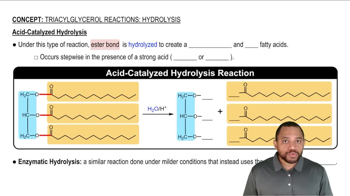
Lipases catalyze hydrolysis reactions. In a hydrolysis reaction, water (H₂O) is used to break chemical bonds. For lipases, this means breaking the ester bonds in triglycerides (a type of lipid).
The general reaction catalyzed by lipases can be represented as: Triglyceride(lipid)+H2OGlycerol+FattyAcids. This reaction breaks the lipid into its components: glycerol and free fatty acids.
Lipases are essential in biological processes such as digestion, where they help break down dietary fats into smaller molecules that can be absorbed by the body.

Verified video answer for a similar problem:

This video solution was recommended by our tutors as helpful for the problem above.
Video duration:
1m
Was this helpful?

Key Concepts

Here are the essential concepts you must grasp in order to answer the question correctly.

Enzyme Function

Enzymes are biological catalysts that speed up chemical reactions in living organisms. They lower the activation energy required for reactions, allowing processes to occur more efficiently. Each enzyme is specific to a particular substrate, meaning it catalyzes a specific type of reaction, which is crucial for metabolic pathways.
Recommended video:
Guided course
02:16
Logarithmic Functions

Lipases

Lipases are a specific class of enzymes that catalyze the hydrolysis of lipids, breaking them down into fatty acids and glycerol. They play a vital role in digestion and metabolism of fats, facilitating the absorption of dietary lipids in the intestines. Lipases are produced in various organs, including the pancreas and stomach.
Recommended video:
Guided course
1:00
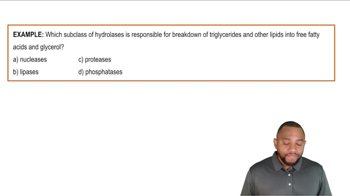
Hydrolases Example 5

Hydrolysis Reaction

Hydrolysis is a chemical reaction in which water is used to break down a compound. In the context of lipases, hydrolysis involves the addition of water to lipids, resulting in the release of fatty acids and glycerol. This reaction is essential for the digestion of dietary fats and the mobilization of stored fats in the body.
Recommended video:
Guided course
3:09
Triacylglycerol Reactions: Hydrolysis Concept 1