Pearson+ LogoPearson+ Logo
Ch.25 Protein and Amino Acid Metabolism
McMurry - Fundamentals of GOB 8th Edition
McMurry8th EditionFundamentals of GOBISBN: 9780134015187Not the one you use?Change textbook
Chapter 25, Problem 56

Determine how many ATPs you would make if you consumed a tetrapeptide comprised of leucine, histidine, valine, and lysine. Have each member of your group take one of the four amino acids and determine the number of ATPs their amino acid would make and combine them to get the total.

Verified step by step guidance
1
Step 1: Understand the problem. The question asks us to calculate the total number of ATP molecules produced from the metabolism of a tetrapeptide composed of leucine, histidine, valine, and lysine. Each amino acid contributes a specific number of ATPs when metabolized, so we need to calculate the ATP yield for each amino acid and sum them up.
Step 2: Break down the tetrapeptide into its individual amino acids: leucine, histidine, valine, and lysine. Each amino acid undergoes a specific catabolic pathway that leads to the production of ATP. Research or refer to the metabolic pathways for each amino acid to determine their ATP yield.
Step 3: For each amino acid, identify its metabolic fate. For example, leucine is ketogenic and is converted into acetoacetate and acetyl-CoA, which enter the citric acid cycle. Similarly, histidine, valine, and lysine have their own unique pathways. Calculate the ATP yield for each amino acid based on these pathways.
Step 4: Add the ATP contributions from all four amino acids. Once you have determined the ATP yield for leucine, histidine, valine, and lysine, sum these values to get the total ATP yield for the tetrapeptide.
Step 5: Consider any additional factors, such as the energy cost of peptide bond hydrolysis during digestion, which may slightly reduce the net ATP yield. Subtract this cost if necessary to refine your total ATP calculation.

Verified video answer for a similar problem:

This video solution was recommended by our tutors as helpful for the problem above.
Video duration:
11m
Was this helpful?

Key Concepts

Here are the essential concepts you must grasp in order to answer the question correctly.

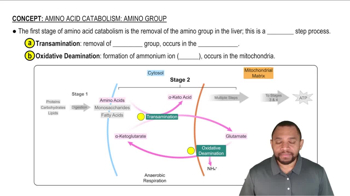
Amino Acid Catabolism

Amino acid catabolism refers to the metabolic process by which amino acids are broken down to produce energy. Each amino acid can enter metabolic pathways at different points, contributing to the production of ATP. The specific pathway and the number of ATP molecules generated depend on the amino acid's structure and the metabolic conditions.
Recommended video:
Guided course
2:21
Amino Acid Catabolism: Amino Group Concept 1

ATP Yield from Amino Acids

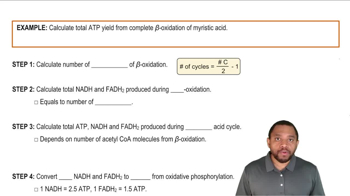
The ATP yield from amino acids varies based on their carbon skeletons and the metabolic pathways they enter. For example, some amino acids can be converted into intermediates of the citric acid cycle, leading to the production of ATP through oxidative phosphorylation. Understanding the specific yield for each amino acid is crucial for calculating the total ATP produced from a tetrapeptide.
Recommended video:
Guided course
4:19
Total Energy from Fatty Acids Example 1

Tetrapeptide Structure and Composition

A tetrapeptide is a molecule composed of four amino acids linked by peptide bonds. The specific sequence and types of amino acids in a tetrapeptide influence its metabolic fate and the energy yield upon catabolism. In this case, analyzing the individual contributions of leucine, histidine, valine, and lysine is essential to determine the overall ATP production from the tetrapeptide.
Recommended video:
Guided course
01:59
Resonance Structures (Simplified) Concept 1