Indicate whether the following processes represent anabolism or catabolism. b. generation of ATP from breakdown of fructose
Verified step by step guidance
1
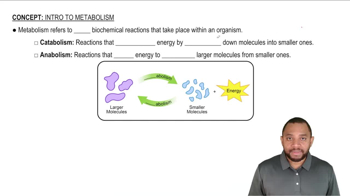
Understand the definitions of anabolism and catabolism: Anabolism refers to the building up of complex molecules from simpler ones, requiring energy input, while catabolism refers to the breakdown of complex molecules into simpler ones, releasing energy.
Identify the process described in the problem: The generation of ATP from the breakdown of fructose involves the chemical breakdown of a sugar molecule (fructose) into smaller components.
Recognize that the breakdown of fructose is a process that releases energy, which is then used to generate ATP. This aligns with the definition of catabolism.
Recall that ATP generation is a key feature of catabolic pathways, as these pathways provide the energy needed for cellular functions.
Conclude that the process described, the generation of ATP from the breakdown of fructose, represents catabolism based on the definitions and characteristics of metabolic pathways.
Verified video answer for a similar problem:
This video solution was recommended by our tutors as helpful for the problem above
Video duration:
2m
Play a video:
Was this helpful?
Key Concepts
Here are the essential concepts you must grasp in order to answer the question correctly.
Anabolism
Anabolism refers to the metabolic processes that build larger molecules from smaller ones, requiring energy input. This includes the synthesis of proteins, nucleic acids, and other macromolecules necessary for cell growth and repair. Anabolic reactions are crucial for maintaining cellular structures and functions.
Catabolism is the set of metabolic pathways that break down molecules into smaller units, releasing energy in the process. This includes the degradation of carbohydrates, fats, and proteins to produce ATP, which cells use for energy. Catabolic reactions are essential for energy production and the recycling of cellular components.
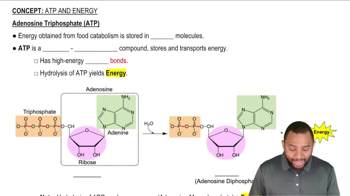
ATP (adenosine triphosphate) generation is a key process in cellular metabolism, where energy is produced through the breakdown of nutrients. In the context of catabolism, the breakdown of fructose leads to the production of ATP, which is then used by cells to perform various functions. Understanding ATP generation is vital for grasping how energy flows within biological systems.