Pearson+ LogoPearson+ Logo
Ch.12 Food as Fuel An Overview of Metabolism
Frost - General, Organic and Biological Chemistry 4th Edition
Frost4th EditionGeneral, Organic and Biological ChemistryISBN: 9780134988696Not the one you use?Change textbook
Chapter 8, Problem 10a

Identify the metabolic nucleotide described by the following:
a. contains a form of the vitamin niacin

Verified step by step guidance
1
Step 1: Understand the problem. The question asks us to identify a metabolic nucleotide that contains a form of the vitamin niacin. Niacin is also known as vitamin B3, and it plays a role in the formation of coenzymes involved in metabolic processes.
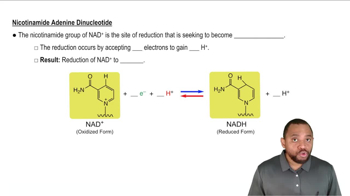
Step 2: Recall the role of niacin in metabolism. Niacin is a precursor for the coenzymes nicotinamide adenine dinucleotide (NAD⁺) and nicotinamide adenine dinucleotide phosphate (NADP⁺). These coenzymes are nucleotides because they contain a nitrogenous base, a sugar, and phosphate groups.
Step 3: Analyze the structure of NAD⁺ and NADP⁺. Both NAD⁺ and NADP⁺ contain a nicotinamide group, which is derived from niacin. This nicotinamide group is essential for their role in redox reactions during metabolism.
Step 4: Consider the function of these nucleotides. NAD⁺ is primarily involved in catabolic reactions (breaking down molecules to release energy), while NADP⁺ is more commonly involved in anabolic reactions (building molecules). Both are critical in energy transfer and metabolic pathways.
Step 5: Conclude that the metabolic nucleotide described in the problem is one that contains a form of niacin, which points to either NAD⁺ or NADP⁺. These are the key nucleotides associated with niacin in metabolism.

Verified video answer for a similar problem:

This video solution was recommended by our tutors as helpful for the problem above.
Video duration:
3m
Was this helpful?

Key Concepts

Here are the essential concepts you must grasp in order to answer the question correctly.

Nicotinamide Adenine Dinucleotide (NAD)

Nicotinamide adenine dinucleotide (NAD) is a coenzyme found in all living cells, playing a crucial role in metabolism. It is derived from niacin (vitamin B3) and is essential for redox reactions, where it alternates between oxidized (NAD+) and reduced (NADH) forms. NAD is vital for energy production, particularly in cellular respiration, and is involved in various biochemical pathways.
Recommended video:
Guided course
2:19
Nicotinamide Adenine Dinucleotide Concept 2

Niacin (Vitamin B3)

Niacin, also known as vitamin B3, is a water-soluble vitamin that is important for converting food into energy. It exists in two forms: nicotinic acid and nicotinamide, both of which are precursors to NAD. Niacin is essential for DNA repair, the production of steroid hormones, and maintaining healthy skin and nerves, making it a critical nutrient in human health.
Recommended video:
Guided course
1:10
Coenzyme A Example 4

Metabolic Nucleotides

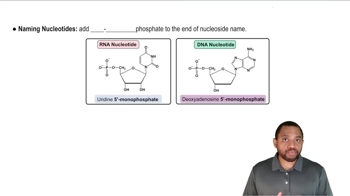
Metabolic nucleotides are organic molecules that serve as the building blocks of nucleic acids and play key roles in cellular metabolism. They include nucleotides like ATP, GTP, and NAD, which are involved in energy transfer, signaling, and enzymatic reactions. Understanding these nucleotides is essential for grasping how cells harness and utilize energy, as well as how they regulate various metabolic pathways.
Recommended video:
Guided course
1:21
Naming Nucleosides and Nucleotides Concept 2