Pearson+ LogoPearson+ Logo
Ch.12 Food as Fuel An Overview of Metabolism
Frost - General, Organic and Biological Chemistry 4th Edition
Frost4th EditionGeneral, Organic and Biological ChemistryISBN: 9780134988696Not the one you use?Change textbook
Chapter 8, Problem 6

Name the types of chemical reactions that tend to be found in anabolic pathways.

Verified step by step guidance
1
Anabolic pathways are involved in the synthesis of complex molecules from simpler ones, which requires energy input.
The primary type of chemical reaction found in anabolic pathways is dehydration synthesis (also known as condensation reactions), where water is removed to form bonds between molecules.
Another common reaction type in anabolic pathways is reduction reactions, where molecules gain electrons, often accompanied by the addition of hydrogen atoms.
Anabolic pathways often involve endergonic reactions, which are reactions that absorb energy from their surroundings.
These reactions are typically coupled with ATP hydrolysis, where the energy released from breaking down ATP is used to drive the anabolic reactions forward.

Verified video answer for a similar problem:

This video solution was recommended by our tutors as helpful for the problem above.
Video duration:
6m
Was this helpful?

Key Concepts

Here are the essential concepts you must grasp in order to answer the question correctly.

Anabolic Pathways

Anabolic pathways are metabolic processes that build larger molecules from smaller units, requiring energy input. These pathways are essential for growth, repair, and maintenance of cells and tissues. Common examples include the synthesis of proteins from amino acids and the formation of nucleic acids from nucleotides.
Recommended video:
Guided course
2:13
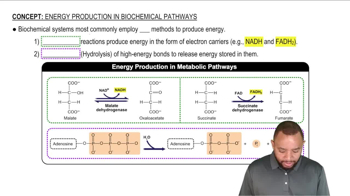
Energy Production In Biochemical Pathways Concept 1

Types of Chemical Reactions

Chemical reactions can be categorized into several types, including synthesis, decomposition, single replacement, and double replacement. In anabolic pathways, synthesis reactions are particularly important as they involve the combination of simpler substances to form complex molecules, which is fundamental for cellular functions and energy storage.
Recommended video:
Guided course
04:07
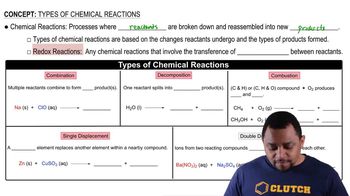
Types of Chemical Reactions Concept 1

Energy Requirement

Anabolic reactions are endergonic, meaning they require an input of energy to proceed. This energy often comes from ATP (adenosine triphosphate), which is generated during catabolic reactions. Understanding the energy dynamics is crucial for comprehending how anabolic pathways function and how they are regulated within the cell.
Recommended video:
Guided course
01:26
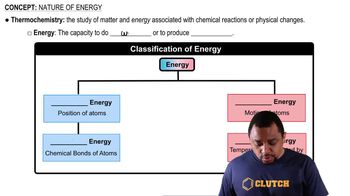
Nature of Energy