Pearson+ LogoPearson+ Logo
Ch.19 Enzymes and Vitamins
McMurry - Fundamentals of GOB 8th Edition
McMurry8th EditionFundamentals of GOBISBN: 9780134015187Not the one you use?Change textbook
Chapter 19, Problem 48

What is the difference between the lock-and-key model of enzyme action and the induced-fit model?

Verified step by step guidance
1
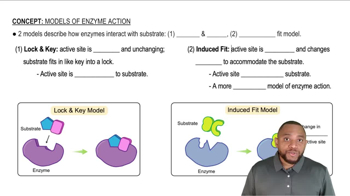
Understand the lock-and-key model: This model suggests that the enzyme's active site has a specific shape that exactly matches the shape of the substrate, like a key fitting into a lock. The substrate binds to the enzyme without requiring any change in the enzyme's structure.
Understand the induced-fit model: This model proposes that the enzyme's active site is flexible and can adjust its shape to fit the substrate. When the substrate binds, the enzyme undergoes a conformational change to create a better fit, enhancing the interaction.
Compare the rigidity of the models: The lock-and-key model assumes a rigid, pre-determined shape for the enzyme's active site, while the induced-fit model emphasizes flexibility and adaptability of the enzyme's structure.
Relate the models to enzyme specificity: Both models explain enzyme specificity, but the induced-fit model provides a more dynamic explanation of how enzymes can accommodate substrates with slight variations in shape.
Summarize the key difference: The lock-and-key model focuses on a perfect pre-existing fit, while the induced-fit model highlights the enzyme's ability to change shape to better interact with the substrate.

Verified video answer for a similar problem:

This video solution was recommended by our tutors as helpful for the problem above.
Video duration:
2m
Was this helpful?

Key Concepts

Here are the essential concepts you must grasp in order to answer the question correctly.

Lock-and-Key Model

The lock-and-key model of enzyme action proposes that enzymes and substrates fit together perfectly, much like a key fits into a lock. This model suggests that the enzyme's active site is rigid and specifically shaped to match the substrate, allowing for a precise interaction. This concept emphasizes the specificity of enzyme-substrate interactions, where only the correct substrate can bind to the enzyme.
Recommended video:
Guided course
1:26
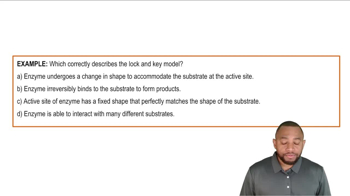
Models of Enzyme Action Example 1

Induced-Fit Model

The induced-fit model expands on the lock-and-key concept by suggesting that the enzyme's active site is flexible and can change shape upon substrate binding. This model posits that the initial interaction between the enzyme and substrate induces a conformational change in the enzyme, enhancing the fit and facilitating the catalytic process. This concept highlights the dynamic nature of enzyme-substrate interactions and the importance of structural adaptability.
Recommended video:
Guided course
2:39
Models of Enzyme Action Concept 1

Enzyme Specificity

Enzyme specificity refers to the ability of an enzyme to selectively catalyze a particular reaction or act on a specific substrate. This specificity is crucial for maintaining metabolic pathways and ensuring that biochemical reactions occur efficiently and accurately. Both the lock-and-key and induced-fit models illustrate different aspects of how enzymes achieve this specificity, impacting their function and regulation in biological systems.
Recommended video:
Guided course
01:37
Specific Gravity