Pearson+ LogoPearson+ Logo
Ch.19 Enzymes and Vitamins
McMurry - Fundamentals of GOB 8th Edition
McMurry8th EditionFundamentals of GOBISBN: 9780134015187Not the one you use?Change textbook
Chapter 19, Problem 83

How can you distinguish between a competitive inhibitor and an uncompetitive inhibitor experimentally?

Verified step by step guidance
1
Design an experiment to measure the enzyme activity (reaction rate) at varying substrate concentrations in the presence and absence of the inhibitor. This will help you observe how the inhibitor affects the enzyme kinetics.
Plot the data on a Michaelis-Menten graph (reaction rate vs. substrate concentration) for both the competitive inhibitor and the uncompetitive inhibitor. Observe the differences in the curves.
To further analyze, create Lineweaver-Burk plots (double reciprocal plots) by plotting 1/[V] (reciprocal of reaction rate) against 1/[S] (reciprocal of substrate concentration) for both inhibitors. This will help you identify the type of inhibition based on the changes in slope and intercepts.
For a competitive inhibitor, observe that the Lineweaver-Burk plot shows an increase in the slope (Km increases) while the y-intercept (1/Vmax) remains constant, indicating that the inhibitor competes with the substrate for the active site.
For an uncompetitive inhibitor, observe that the Lineweaver-Burk plot shows parallel lines with both the slope and y-intercept changing (both Km and Vmax decrease), indicating that the inhibitor binds to the enzyme-substrate complex rather than the active site.

Verified video answer for a similar problem:

This video solution was recommended by our tutors as helpful for the problem above.
Video duration:
4m
Was this helpful?

Key Concepts

Here are the essential concepts you must grasp in order to answer the question correctly.

Competitive Inhibition

Competitive inhibition occurs when an inhibitor molecule competes with the substrate for binding to the active site of an enzyme. This type of inhibition can be overcome by increasing the concentration of the substrate, as it effectively reduces the likelihood of the inhibitor binding. The presence of a competitive inhibitor typically increases the Km (Michaelis constant) of the enzyme without affecting the Vmax (maximum reaction velocity).
Recommended video:
Guided course
1:19
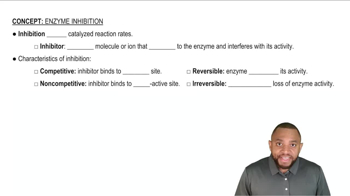
Enzyme Inhibition Concept 1

Uncompetitive Inhibition

Uncompetitive inhibition happens when an inhibitor binds to the enzyme-substrate complex, preventing the complex from releasing products. This type of inhibition decreases both the Km and Vmax of the enzyme, as it effectively locks the substrate in place. Uncompetitive inhibitors are not affected by substrate concentration, making their effects distinct from competitive inhibitors in experimental settings.
Recommended video:
Guided course
1:19
Enzyme Inhibition Concept 1

Experimental Distinction Methods

To distinguish between competitive and uncompetitive inhibitors experimentally, one can analyze the enzyme kinetics using Lineweaver-Burk plots or Michaelis-Menten kinetics. Competitive inhibitors will show an increase in the slope of the Lineweaver-Burk plot, while uncompetitive inhibitors will shift the y-intercept. By measuring changes in Km and Vmax under varying substrate concentrations, researchers can identify the type of inhibition present.
Recommended video:
Guided course
05:50
Experimental Error