Pearson+ LogoPearson+ Logo
Ch.19 Enzymes and Vitamins
McMurry - Fundamentals of GOB 8th Edition
McMurry8th EditionFundamentals of GOBISBN: 9780134015187Not the one you use?Change textbook
Chapter 19, Problem 80

Look up the structures of vitamin C and vitamin E on the Web, and identify the functional groups in these vitamins.

Verified step by step guidance
1
Search for the chemical structures of vitamin C (ascorbic acid) and vitamin E (tocopherol) using reliable sources such as scientific databases or trusted websites.
Examine the structure of vitamin C. Identify the functional groups present, such as hydroxyl (-OH) groups, a lactone ring (a cyclic ester), and any other relevant features.
Examine the structure of vitamin E. Identify the functional groups present, such as hydroxyl (-OH) groups on the aromatic ring, an ether group, and the long hydrocarbon tail.
Review the definitions of the identified functional groups to ensure you understand their chemical properties and roles in the molecules.
Summarize the functional groups found in each vitamin and consider how these groups contribute to the vitamins' chemical behavior and biological functions.

Verified video answer for a similar problem:

This video solution was recommended by our tutors as helpful for the problem above.
Video duration:
1m
Was this helpful?

Key Concepts

Here are the essential concepts you must grasp in order to answer the question correctly.

Functional Groups

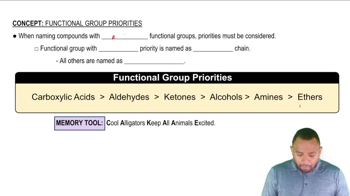
Functional groups are specific groups of atoms within molecules that are responsible for the characteristic chemical reactions of those molecules. They determine the properties and reactivity of organic compounds. Common functional groups include hydroxyl (-OH), carboxyl (-COOH), and ester (-COO-) groups, which can be found in various vitamins.
Recommended video:
Guided course
1:11
Functional Group Priorities Concept 1

Vitamin C Structure

Vitamin C, also known as ascorbic acid, has a structure that includes multiple hydroxyl groups and a lactone ring. These functional groups contribute to its antioxidant properties and its role in collagen synthesis. Understanding its structure helps in recognizing how it interacts with other molecules in biological systems.
Recommended video:
Guided course
1:03
Structural Formula Example 2

Vitamin E Structure

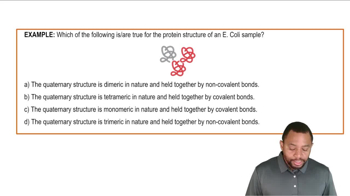
Vitamin E primarily exists in the form of tocopherols and tocotrienols, which contain a chromanol ring and a long phytyl side chain. The hydroxyl group on the chromanol ring is crucial for its antioxidant activity, allowing it to protect cell membranes from oxidative damage. Analyzing its structure reveals how it functions in the body.
Recommended video:
Guided course
1:13
Quaternary Protein Structure Example 1