Pearson+ LogoPearson+ Logo
Ch.19 Enzymes and Vitamins
McMurry - Fundamentals of GOB 8th Edition
McMurry8th EditionFundamentals of GOBISBN: 9780134015187Not the one you use?Change textbook
Chapter 19, Problem 86f

How will changing the conditions in an enzymatic reaction affect the rate of that reaction? Explain why in each case.
f. Decreasing the amount of substrate by half

Verified step by step guidance
1
Understand the relationship between substrate concentration and enzymatic reaction rate: Enzymatic reactions typically follow Michaelis-Menten kinetics, where the rate of reaction depends on the substrate concentration. At lower substrate concentrations, the reaction rate is directly proportional to the substrate concentration.
Identify the effect of decreasing substrate concentration: By halving the substrate concentration, the number of substrate molecules available to bind to the enzyme's active sites decreases, which reduces the frequency of enzyme-substrate collisions.
Explain the impact on the reaction rate: With fewer enzyme-substrate complexes forming, the overall rate of the reaction will decrease, especially if the substrate concentration is below the enzyme's saturation point (where all active sites are occupied).
Consider the role of the enzyme's Km value: The Km (Michaelis constant) represents the substrate concentration at which the reaction rate is half of its maximum (Vmax). If the new substrate concentration is significantly below the Km, the reaction rate will drop substantially.
Summarize the outcome: Decreasing the substrate concentration by half will reduce the reaction rate because the enzyme has fewer substrate molecules to act upon, leading to fewer product molecules being formed per unit of time.

Verified video answer for a similar problem:

This video solution was recommended by our tutors as helpful for the problem above.
Video duration:
3m
Was this helpful?

Key Concepts

Here are the essential concepts you must grasp in order to answer the question correctly.

Enzyme-Substrate Interaction

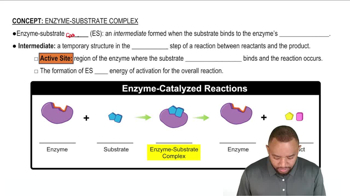
Enzymes are biological catalysts that speed up reactions by binding to substrates, forming an enzyme-substrate complex. The rate of reaction is influenced by the concentration of substrates; as substrate concentration increases, more enzyme active sites are occupied, leading to a higher reaction rate until a saturation point is reached.
Recommended video:
Guided course
2:32
Enzyme-Substrate Complex Concept 1

Michaelis-Menten Kinetics

Michaelis-Menten kinetics describes the rate of enzymatic reactions by relating reaction rate to substrate concentration. It introduces parameters like Vmax (maximum reaction rate) and Km (substrate concentration at which the reaction rate is half of Vmax), helping to predict how changes in substrate levels affect reaction rates.
Recommended video:
Guided course
01:19
Kinetic Molecular Theory Concept 1

Reaction Rate and Limiting Factors

The reaction rate of an enzymatic process can be limited by various factors, including substrate concentration, enzyme concentration, and environmental conditions (like pH and temperature). Decreasing substrate concentration can lead to a slower reaction rate, as fewer substrate molecules are available to bind to the enzyme, reducing the overall efficiency of the reaction.
Recommended video:
Guided course
01:07
Rate of Reaction Concept 1