Pearson+ LogoPearson+ Logo
Ch.19 Enzymes and Vitamins
McMurry - Fundamentals of GOB 8th Edition
McMurry8th EditionFundamentals of GOBISBN: 9780134015187Not the one you use?Change textbook
Chapter 19, Problem 25d

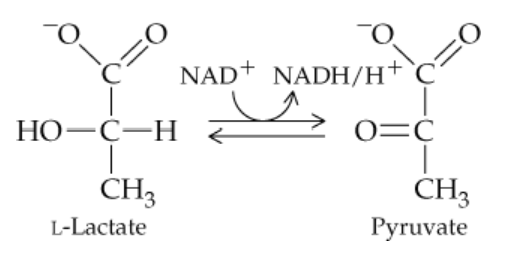
Answer questions (a)–(e) concerning the following reaction:
Chemical reaction diagram showing the conversion between L-Lactate and Pyruvate with NAD+ and NADH/H+ as co-factors.
d. What is the product for the reaction as written?

Verified step by step guidance
1
Identify the type of reaction taking place (e.g., synthesis, decomposition, single replacement, double replacement, or combustion). This will help predict the product.
Examine the reactants in the given reaction. Look for functional groups, ions, or elements that might interact to form the product.
Apply the law of conservation of mass, which states that the number of atoms of each element must be the same on both sides of the reaction. This ensures the product is balanced.
Determine the possible product(s) based on the reactivity and compatibility of the reactants. For example, if it is a double replacement reaction, swap the cations or anions of the reactants to form the products.
Write the chemical formula of the product(s) and ensure the reaction is balanced by adjusting coefficients as necessary.

Verified video answer for a similar problem:

This video solution was recommended by our tutors as helpful for the problem above.
Video duration:
56s
Was this helpful?

Key Concepts

Here are the essential concepts you must grasp in order to answer the question correctly.

Chemical Reaction

A chemical reaction involves the transformation of reactants into products through the breaking and forming of chemical bonds. Understanding the type of reaction (e.g., synthesis, decomposition, single replacement, double replacement, or combustion) is crucial for predicting the products formed. The specific conditions and reactants involved will dictate the outcome of the reaction.
Recommended video:
Guided course
00:58
Chemical Reaction: Chemical Change Concept 1

Stoichiometry

Stoichiometry is the calculation of reactants and products in chemical reactions based on the balanced chemical equation. It allows chemists to determine the proportions of substances involved and predict the amounts of products formed from given quantities of reactants. Mastery of stoichiometric principles is essential for accurately answering questions about reaction products.
Recommended video:
Guided course
01:16
Stoichiometry

Reaction Mechanism

A reaction mechanism describes the step-by-step sequence of elementary reactions that lead to the overall chemical change. Understanding the mechanism can provide insights into the nature of the products formed and the conditions required for the reaction to proceed. It often involves intermediates and transition states that are crucial for comprehending how reactants convert to products.
Recommended video:
Guided course
1:30
Alcohol Reactions: Dehydration Reactions Concept 1