Pearson+ LogoPearson+ Logo
Ch.15 Aldehydes and Ketones
McMurry - Fundamentals of GOB 8th Edition
McMurry8th EditionFundamentals of GOBISBN: 9780134015187Not the one you use?Change textbook
Chapter 15, Problem 30a

Draw structures corresponding to the following aldehyde and ketone names:
a. 3-Methylpentanal

Verified step by step guidance
1
Identify the parent chain: The name '3-Methylpentanal' indicates that the parent chain is 'pentanal,' which is a five-carbon aldehyde. The '-al' suffix specifies the presence of an aldehyde functional group (-CHO) at the terminal carbon.
Number the carbon chain: Start numbering the carbon atoms from the end closest to the aldehyde group. This ensures the aldehyde group is at carbon-1.
Locate the substituent: The '3-Methyl' prefix indicates that there is a methyl group (-CH₃) attached to carbon-3 of the parent chain.
Draw the structure: Begin by drawing a straight chain of five carbon atoms. Attach the aldehyde group (-CHO) to carbon-1 and the methyl group (-CH₃) to carbon-3.
Double-check the structure: Verify that the aldehyde group is at carbon-1, the methyl group is at carbon-3, and the total number of carbons in the chain matches the name (5 carbons in the parent chain plus the methyl substituent).

Verified video answer for a similar problem:

This video solution was recommended by our tutors as helpful for the problem above.
Was this helpful?

Key Concepts

Here are the essential concepts you must grasp in order to answer the question correctly.

Aldehydes

Aldehydes are organic compounds characterized by the presence of a carbonyl group (C=O) at the end of a carbon chain. The general formula for aldehydes is RCHO, where R represents a hydrocarbon group. In the case of 3-Methylpentanal, the 'pentanal' indicates a five-carbon chain with the aldehyde functional group at one end, while '3-methyl' specifies a methyl group attached to the third carbon of the chain.
Recommended video:
Guided course
0:34
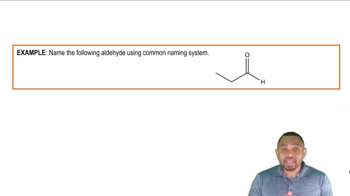
Naming Aldehydes Example 2

Structural Representation

Structural representation in organic chemistry involves depicting the arrangement of atoms within a molecule. This can be done using various methods, such as Lewis structures, condensed formulas, or skeletal formulas. For 3-Methylpentanal, drawing the structure requires accurately placing the carbon chain and functional groups to reflect the molecular formula and connectivity of the atoms.
Recommended video:
Guided course
2:08
Molecular Representations Concept 1

IUPAC Nomenclature

IUPAC nomenclature is a systematic method for naming organic chemical compounds based on their structure. It provides rules for identifying the longest carbon chain, functional groups, and substituents. Understanding IUPAC nomenclature is essential for interpreting names like 3-Methylpentanal, as it guides the construction of the corresponding molecular structure by indicating the position and type of substituents on the main carbon chain.
Recommended video:
Guided course
3:18
IUPAC Naming Concept 3