Pearson+ LogoPearson+ Logo
Ch.15 Aldehydes and Ketones
McMurry - Fundamentals of GOB 8th Edition
McMurry8th EditionFundamentals of GOBISBN: 9780134015187Not the one you use?Change textbook
Chapter 15, Problem 32a

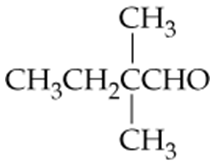
Give systematic names for the following aldehydes and ketones:
a.

Verified step by step guidance
1
Identify the functional group in each compound. Aldehydes have a carbonyl group (C=O) bonded to at least one hydrogen atom, while ketones have a carbonyl group bonded to two carbon atoms.
Determine the longest continuous carbon chain that includes the carbonyl group. This chain will serve as the parent chain for naming.
Number the parent chain starting from the end closest to the carbonyl group. For aldehydes, the carbonyl carbon is always carbon-1. For ketones, assign the lowest possible number to the carbonyl carbon.
Name the parent chain based on the number of carbons, using the appropriate suffix: '-al' for aldehydes and '-one' for ketones. For ketones, include the position of the carbonyl group in the name.
Add prefixes for any substituents attached to the parent chain, listing them in alphabetical order. Use numbers to indicate their positions on the chain.

Verified video answer for a similar problem:

This video solution was recommended by our tutors as helpful for the problem above.
Video duration:
4m
Was this helpful?

Key Concepts

Here are the essential concepts you must grasp in order to answer the question correctly.

Aldehydes

Aldehydes are organic compounds characterized by the presence of a carbonyl group (C=O) at the end of a carbon chain. The general formula for aldehydes is RCHO, where R represents a hydrocarbon group. Systematic naming involves identifying the longest carbon chain containing the carbonyl group and using the suffix '-al' to denote its presence, such as in 'pentanal' for a five-carbon aldehyde.
Recommended video:
Guided course
0:34
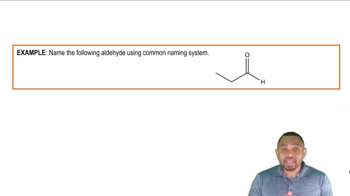
Naming Aldehydes Example 2

Ketones

Ketones are organic compounds that contain a carbonyl group (C=O) located within a carbon chain, rather than at the end. Their general formula is RC(=O)R', where R and R' are hydrocarbon groups. When naming ketones systematically, the longest carbon chain containing the carbonyl group is identified, and the suffix '-one' is used, as in 'butanone' for a four-carbon ketone.
Recommended video:
Guided course
1:29
Ketone Bodies Concept 1

IUPAC Nomenclature

IUPAC nomenclature is a systematic method for naming chemical compounds, ensuring that each name conveys specific structural information. For aldehydes and ketones, the IUPAC rules dictate the identification of the longest carbon chain, the position of the carbonyl group, and the appropriate suffixes. This standardized approach allows chemists to communicate compound structures clearly and unambiguously.
Recommended video:
Guided course
3:18
IUPAC Naming Concept 3