Pearson+ LogoPearson+ Logo
Ch.2 Atoms and the Periodic Table
McMurry - Fundamentals of GOB 8th Edition
McMurry8th EditionFundamentals of GOBISBN: 9780134015187Not the one you use?Change textbook
Chapter 2, Problem 28

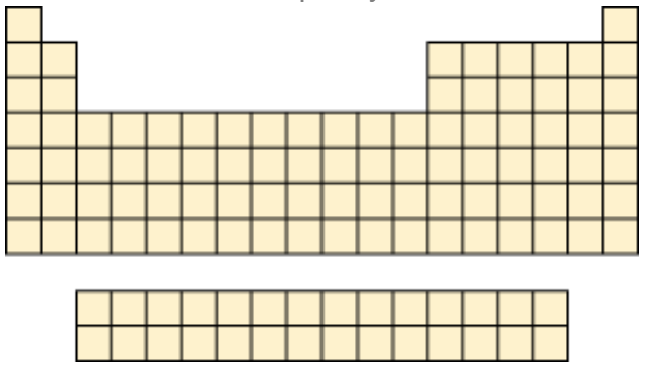
Use the following blank periodic table to show where the elements matching the following descriptions appear.
a. Elements with the valence-shell electron configuration ns2 np5
b. An element whose third shell contains two p electrons
c. Elements with a completely filled valence shell
Blank periodic table with labeled groups for identifying elements based on specific electron configurations.

Verified step by step guidance
1
Step 1: Identify the elements with the valence-shell electron configuration ns^2 np^5. These elements belong to Group 17 (halogens) on the periodic table. Locate Group 17 on the blank periodic table and mark the corresponding positions.
Step 2: For the element whose third shell contains two p electrons, determine the electron configuration. The third shell corresponds to n=3, and two p electrons indicate the configuration 3p^2. This corresponds to silicon (Si), which is in Group 14 and Period 3. Locate this position on the blank periodic table and mark it.
Step 3: Identify the elements with a completely filled valence shell. These elements are noble gases, which belong to Group 18. Locate Group 18 on the blank periodic table and mark the corresponding positions.
Step 4: Review the periodic table layout to ensure the correct groups and periods are marked based on the descriptions provided. Double-check the electron configurations for accuracy.
Step 5: Label the marked positions with the appropriate element symbols (e.g., F, Cl, Br for halogens; Si for the element with 3p^2; He, Ne, Ar for noble gases) to complete the task.

Verified video answer for a similar problem:

This video solution was recommended by our tutors as helpful for the problem above.
Video duration:
3m
Was this helpful?

Key Concepts

Here are the essential concepts you must grasp in order to answer the question correctly.

Valence Shell Electron Configuration

The valence shell electron configuration describes the distribution of electrons in the outermost shell of an atom. It is crucial for determining an element's chemical properties and reactivity. For example, the configuration ns^2 np^5 indicates elements in Group 17 (halogens), which are highly reactive due to their tendency to gain one electron to achieve a stable octet.
Recommended video:
Guided course
01:04
Valence Shell Electron Pair Repulsion Theory (Simplified) Concept 1

Electron Shells and Subshells

Electron shells are the regions around an atom's nucleus where electrons are likely to be found, with each shell corresponding to a principal energy level. Subshells (s, p, d, f) further divide these shells based on the shape of the electron cloud. Understanding the arrangement of electrons in these shells helps identify elements based on their electron configurations, such as those with two p electrons in the third shell.
Recommended video:
Guided course
00:53
Electronic Structure: Subshells Example 1

Noble Gas Configuration

A completely filled valence shell, often referred to as noble gas configuration, occurs when an atom has a full outer shell of electrons, typically consisting of eight electrons (octet rule). Elements with this configuration, such as the noble gases, are chemically inert and do not readily react with other elements. Recognizing these configurations is essential for predicting element behavior in chemical reactions.
Recommended video:
Guided course
01:08
The Electron Configuration: Condensed